
All Articles
Filter by Category
Archive
- Tradecraft & Analyst Skills
- Productivity & Reporting
- Generative AI
- Writing & Communication
- Cyber Threats & Security
- Humans & AI
- Search & Discovery
- Help Center
- emergency response
- geopolitical
- OSINT
- Live Events
- Popular
- Templates
- Wild Dog AI Podcast
- Corporate
- Finance
- Medical
- Communication Strategy
- Politics
- Private Investigation

Reducing Cognitive Load in Intelligence Work: Tools, Tactics, and Tradeoffs
Workers who report the largest AI productivity gains also report the most burnout, and BCG has named the mental fatigue that comes from overseeing AI output. In intelligence and security work, cognitive load builds from routine volume, tool sprawl, report production, and the effort of checking AI drafts against their sources. This piece covers four ways to reduce it while the analyst keeps control of judgment and review.
The Analyst Productivity Trap: Why More Tools Don’t Mean Faster Reports
It's 4 PM on a Wednesday, your report is due tomorrow, and you've got six tabs open across four different tools — none of which talk to each other. The instinct is always to add one more tool to fix the gap. See why that instinct is backwards, and what actually happens to reporting speed when the seams between tools disappear instead.
What Is an AI SITREP? How Teams Generate Situational Reports Automatically
Is "AI SITREP" a real category, or just ChatGPT dressed up in operational language? It's real — but the difference between the two comes down to process, not vocabulary. See what actually separates a structured, source-grounded situational report from notes pasted into a chatbot, and why that distinction matters the moment someone challenges a claim.
How High-Performing Intelligence Teams Cut Reporting Time Without Cutting Corners
Five habits are quietly draining hours from every intelligence reporting cycle: scattered data sources, rebuilding report structure from scratch, version chaos in shared drives, citations chased down after the fact, and one AI model forced to write every section. None of them look like a problem until deadline pressure makes them one. Here's what closing each one actually looks like.
Designing a Repeatable Briefing Process for Intelligence
Analysts aren't losing time to bad instincts — they're losing it to rebuilding the same source collections, templates, and reviews from scratch every cycle. Here's why consistency in intelligence output is an infrastructure problem, not a discipline one, and what changes when the scaffolding actually holds.

The 4:45 PM Tasker: How Analysts Use GenAI When Leadership Needs Answers Before COB
At 4:47 PM, Mira gets a Slack message: leadership needs a geopolitical intelligence brief on the South Caucasus, presentation-ready, by close of business. This post walks through exactly how she builds it — from scoping the intelligence question to curating a source collection, generating a structured first draft, and delivering a fully cited, defensible product in under two hours.
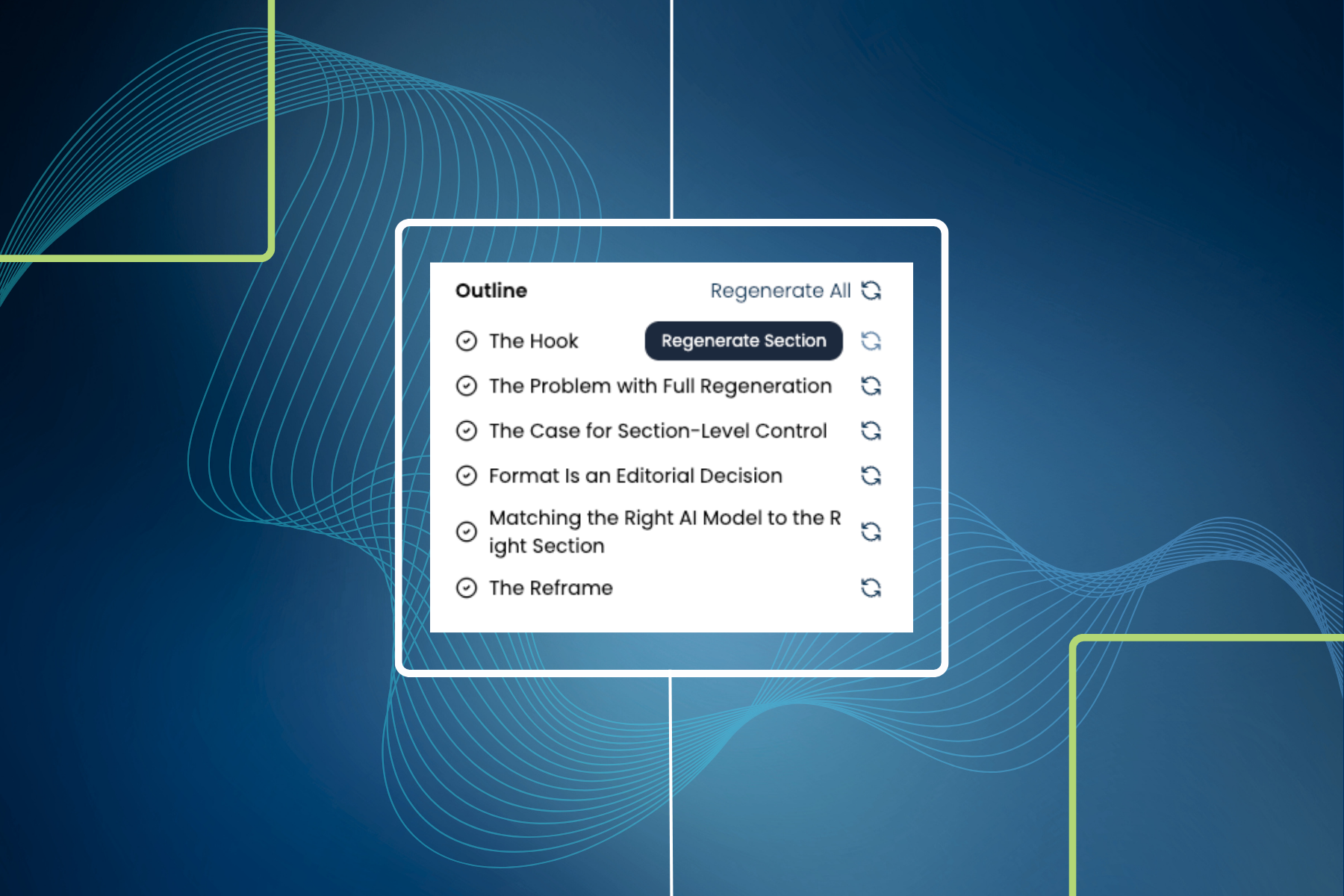
Why Section-Level Regeneration Produces Better AI Reports
Most analysts have been there: one weak section in an otherwise solid report, and the temptation to hit regenerate and start fresh. The problem is that full regeneration treats every section as equally flawed — wiping out verified work to fix one paragraph. This post breaks down why section-level control produces better reports, how targeted instructions outperform global rewrites, and how matching the right AI model to the right section changes the quality of the final product.

Breaking News, No Context: How Intelligence Teams Handle Fast-Moving Events Without Guessing
When a breaking physical security event hits, the information environment doesn't get clearer as more data arrives — it gets noisier. Rumor, speculation, and verified reporting arrive in the same feeds at the same speed, and the pressure to produce something fast is exactly when the worst intelligence mistakes get made. This piece follows Leo, a crisis intelligence analyst, through the four-stage workflow that separates defensible analysis from educated guessing: triaging before typing, building an attributed collection under pressure, generating a confidence-calibrated first draft, and reviewing with the skepticism the moment demands.
The Real ROI of Faster Intelligence Reports: It's Not Just Time Savings
When intelligence teams justify reporting tools, the argument almost always centers on hours saved. That metric is real — but it captures only the most visible layer of the value. This piece makes the fuller case: how report accuracy affects the quality of decisions made from it, how faster reports compress the window between an event and an organizational response, how consistent quality builds analyst credibility with leadership over time, and how reporting infrastructure that preserves institutional knowledge compounds in value with every cycle.
How to Audit Your Current Reporting Workflow Before You Adopt Any New Tool
Most tool evaluations fail before they start — not because the software isn't capable, but because teams don't actually know where their current workflow is breaking down. Run this audit before your next vendor demo and you'll ask sharper questions, evaluate more honestly, and make a decision that actually sticks.
Onboarding a New Analyst? Here's How to Use Your Existing Report Archive as a Training Asset
When an experienced analyst leaves, they take more than their expertise — they take the reasoning, source logic, and analytical judgment that made their work credible. This piece breaks down how intelligence teams can use their existing report archive, templates, and source collections as a structured onboarding asset, so new analysts inherit a tested framework instead of starting from scratch. The result is faster ramp time, more consistent output, and institutional knowledge that compounds instead of walking out the door.
How Intelligence Teams Evaluate AI Reporting Tools: A Buyer's Checklist
This guide breaks down how to evaluate AI reporting tools across accuracy, security, workflow, and governance. It highlights the questions that actually matter in high-stakes environments, from hallucination risk to data handling policies. If you’re considering an AI tool, this is the checklist to bring into every vendor conversation.
3 Finance Intelligence Reports Watchfloor Analysts Can Deliver in Record Time Using Indago
Watchfloor analysts in finance and market intelligence face a pressure most roles don't: leadership needs answers before the market reacts, and the window between a breaking event and an executive briefing is often measured in minutes.
This piece walks through the three reports that define success in this role, the specific workflow challenges each one creates, how the best analysts are producing these accurately and under pressure — and what the right tooling actually makes possible.

Briefing the Boss: Turning Raw Findings into Executive-Ready Reports Without Rewriting Everything
Most analysts don't have a research problem… they have a last mile problem. The analysis gets done in hours; the reformatting to match a boss's specific preferences takes just as long.
This piece walks through five of the most common stakeholder quirks analysts deal with, and how to encode those preferences directly into your Indago report templates so every report starts from the right place instead of a blank page.
Why Human-in-the-Loop AI Is Essential for Intelligence and Security Operations
As AI adoption accelerates across intelligence and security operations, many organizations measure success by how many humans they remove from the workflow. In high-stakes environments, that approach creates serious risk. Yet this framework fundamentally misunderstands productivity in intelligence environments, where the cost of error far exceeds the cost of human oversight.
Are AI-Generated SITREPs Reliable? Verification, Sources, and Human Oversight
AI-generated situation reports achieve reliability through systematic verification, not through AI sophistication alone. Organizations that implement structured oversight processes consistently produce trustworthy AI intelligence products.
1 Incident, 3 Reports: How Analysts Create Tailored Reports for SOC, Executives, and Legal in Under an Hour
A single cyber incident rarely needs one report — it needs three: the SOC wants IOCs now, executives want risk clarity, and legal wants defensible documentation. See how one analyst turns the same dataset into three audience-specific briefings in under an hour using structured workflows instead of hours of rewriting.

AI Was Supposed to Save Time. Why Are Teams Busier Than Ever?
The promise of AI was simple: automate routine tasks, free up analysts for higher-value work, and finally give teams the breathing room they've been seeking. Instead, many organizations find themselves caught in a productivity paradox—doing more work, not better work.
The 30-Minute SITREP: How Teams Turn Daily Intelligence Updates Around Before Standup
Teams using Indago report consistent 70% reductions in SITREP production time, with some achieving the full 30-minute target within their first week of implementation. The time savings are strategic, allowing analysts to dedicate more attention to emerging threats and deeper analysis.

What Makes a Modern Intelligence Reporting Platform (& Why Legacy Tools Fall Short)
Modern intelligence work demands more than stitched‑together tools and static documents. Teams using Indago report measurable improvements—AI‑generated first drafts that are 75–85% complete, 7+ days saved on complex products, and roughly 30% reductions in per‑report production costs—while keeping analysts firmly in control.