
The 30-Minute SITREP: How Teams Turn Daily Intelligence Updates Around Before Standup
It's 7:30 AM, and while most of the world is still grabbing their first cup of coffee, intelligence teams are already deep into their morning briefing cycle.
The challenge? Turning overnight developments into actionable intelligence before the 8:00 AM leadership standup.
For many teams, this means analysts get to work at 5:30 AM to manually comb through overnight alerts, piece together fragmented updates, and draft situational reports (SITREPs) that often feel outdated by the time they reach decision-makers.
What if we told you we could get your morning brief done in 30 minutes tops?
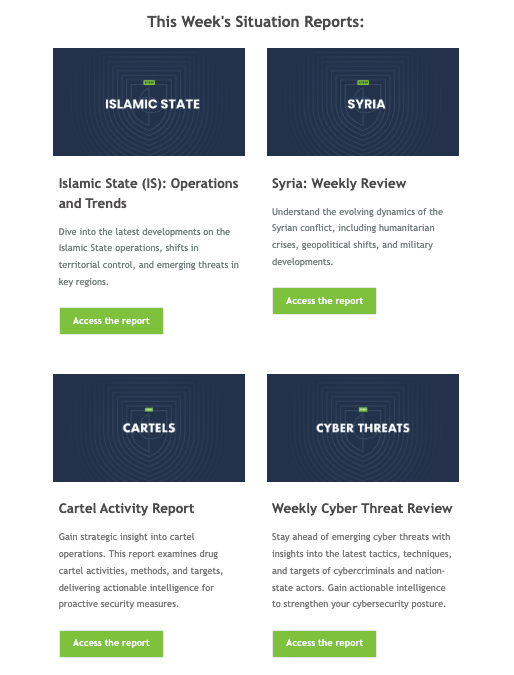
Snapshot from Indago’s weekly SITREP Newsletter. Click to sign up.
The Daily Intelligence Bottleneck
Every single morning, these analysts face the same operational dilemma: how do you consistently produce high-quality situational awareness in the narrow window between when events happen and when leaders need to act?
Traditional reporting workflows demand 3-4 hours of manual effort—scanning multiple feeds, cross-referencing sources, formatting findings, and ensuring analytic rigor. But in a world where threats evolve by the hour and competitive landscapes shift overnight, waiting until noon for yesterday's intelligence isn't an option.
Unfortunately, talented analysts spend their most productive hours on formatting and data wrangling rather than the critical thinking and pattern recognition that actually drives operational advantage. Teams either sacrifice thoroughness for speed, or deliver comprehensive reports that arrive too late to influence morning decisions.
The Intelligence Team's Morning Dilemma
Let’s pretend that at 6:30 AM, intelligence analyst Sarah sits down at her desk with a fresh cup of coffee and a familiar knot in her stomach. In just 3 hours, she needs to deliver a comprehensive situational report to the morning briefing. The same process that took her team 4 hours yesterday. And the day before. And every day this week.
Sound familiar? Across intelligence, security, and analysis teams worldwide, the daily SITREP has become a productivity bottleneck—not because the work isn't important, but because the process hasn't evolved with the tools available.
The Hidden Cost of Manual Daily Briefings
The real cost isn't just time—it's opportunity. While Sarah struggles with paragraph formatting and citation styles, emerging threats develop unchecked. Critical analysis gets rushed. And by the time decision-makers receive their briefing, the intelligence is already hours old.
Research from intelligence workflow studies shows that analysts spend up to 65% of their time on administrative tasks rather than actual analysis. For daily briefings, this ratio becomes even more skewed, with teams often dedicating entire mornings to what should be a streamlined update process.
The 30-Minute Solution: Structured Workflows Over Manual Chaos
However, the right workflow can compress a 4-hour SITREP into a 30-minute process without sacrificing quality. The secret lies not in cutting corners, but in eliminating waste.
Consider how elite military briefing teams operate. They don't reinvent their process each morning. They follow proven workflows that ensure consistency, speed, and thoroughness. Intelligence teams can apply the same principle to their daily reporting.
The transformation starts with 3 core elements: structured collection protocols, reusable report templates, and guided drafting processes. When these work together, the traditional SITREP bottleneck disappears.
Breaking Down the 30-Minute Workflow
When Sarah clocks into work in the morning, here’s how long it should take her to complete her daily SITREP in minutes, not hours. All it takes is the right reporting tools and optimized workflow.
Minutes 1-15: Rapid Collection - Instead of wandering through news sites and databases, analysts use predefined source lists and automated collection tools. Key overnight developments are tagged and categorized as they're discovered, not after hours of reading.
Minutes 16-18: Structured Assembly - Pre-built templates guide analysts through essential sections—threat updates, operational changes, regional developments—ensuring nothing critical gets missed while maintaining consistent formatting.
Minutes 19-25: Guided Drafting - Rather than starting from a blank page, analysts work within frameworks that prompt for key information. Critical assessments get proper attention while routine updates move quickly through standardized formats.
Minutes 26-30: Review and Distribution - Final quality checks focus on analysis rather than formatting. Distribution happens through established channels with consistent metadata and classification markings.
This process eliminates the administrative friction that prevents teams from focusing on what matters most: delivering timely, actionable intelligence. Then, Sarah will have hours of extra time on her hands she can spend conducting proactive analyses, pursuing new leads, and thinking more critically without worrying about busywork.
The Indago Advantage: Purpose-Built for Intelligence Workflows
Indago transforms the daily SITREP from a time-consuming manual process into a streamlined workflow designed specifically for intelligence professionals.
The platform combines streamlined collection capabilities with analyst-controlled report generation, ensuring teams maintain oversight while dramatically reducing production time. Here’s how:
Collection acceleration happens through Indago's integrated search capabilities and Chrome extension, allowing analysts to rapidly gather relevant information from multiple sources without the usual tab-switching chaos.
Template consistency ensures every SITREP follows organizational standards while adapting to the day's specific developments.
Indago's guided drafting features help analysts move from collection to first draft in minutes, not hours.
The platform detects bias, maintains proper formatting, and ensures critical elements aren't overlooked—all while keeping the analyst firmly in control of content and analysis.
Teams using Indago report consistent 70% reductions in SITREP production time, with some achieving the full 30-minute target within their first week of implementation. The time savings are strategic, allowing analysts to dedicate more attention to emerging threats and deeper analysis.
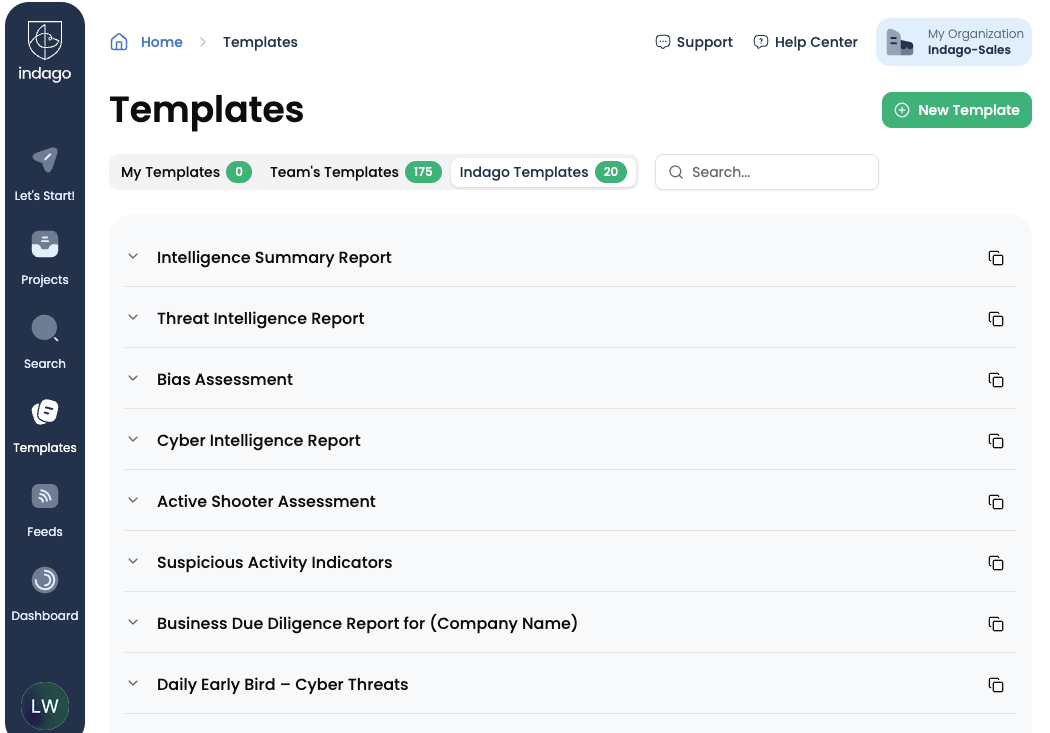
Snapshot of Indago’s pre-built template library.
Beyond Speed: Quality and Consistency Gains
And the benefits of structured SITREP workflows extend far beyond time savings. Consistent formatting means stakeholders can quickly locate critical information. Standardized sections ensure nothing important gets buried in dense paragraphs. And reliable delivery schedules help decision-makers plan their own workflows around predictable intelligence updates.
Perhaps most importantly, when routine reporting becomes efficient, analysts have bandwidth for the proactive work that truly adds value: trend analysis, deep dives into emerging threats, and strategic assessments that inform long-term planning.
Teams also discover that structured workflows improve quality under pressure. When time is short—during crisis response or breaking situations—having proven processes prevents important details from being overlooked or critical assessments from being rushed.
The Ripple Effect: How Efficient SITREPs Transform Operations
When daily briefings consistently arrive on time with reliable quality, entire organizational rhythms improve. Leadership can schedule decision meetings with confidence. Operations teams can plan around predictable intelligence updates. Analysis priorities can focus on emerging issues rather than catching up on delayed reporting.
The transformation often surprises teams with secondary benefits. Analysts report reduced stress and improved job satisfaction when their mornings aren't dominated by formatting tasks. Supervisors find they can dedicate more time to strategic guidance rather than quality control on rushed reports. And organizations discover they can maintain the same intelligence coverage with smaller teams or expand coverage without adding staff.
Key Takeaways
The shift from multi-hour manual reporting to 30-minute structured workflows represents a fundamental change in how intelligence teams operate. By implementing standardized templates, reusable collection protocols, and guided drafting processes, teams can dramatically reduce the cognitive load of daily reporting while maintaining—and often improving—the quality and consistency of their intelligence products.
A well-designed SITREP workflow transforms routine reporting from a time sink into a force multiplier, enabling teams to deliver timely insights that actually influence decision-making.
Most importantly, this approach recognizes that analysts are strategic thinkers, not document formatters. Technology should handle the mechanical aspects of report generation, freeing human expertise to focus on the nuanced interpretation and contextualization that no algorithm can replicate. When teams get this balance right, they don't just produce faster reports—they produce better intelligence.
The Path Forward: Accelerating Your Intelligence Operations
The question isn't whether your team can afford to implement standardized reporting workflows. The question is whether you can afford not to. While you're spending hours on a daily brief, your competitors and adversaries are already acting on their intelligence.
Indago's intelligence reporting platform provides the structured templates, reusable workflows, and guided drafting capabilities that make this transformation possible. We've designed Indago specifically for intelligence professionals who understand that speed without accuracy is worthless—and that accuracy without speed can be equally dangerous in today's threat environment.
Ready to transform your daily intelligence operations? Sign up for a demo to learn more about how Indago can accelerate your intelligence operations and help your team achieve the 30-minute SITREP standard. Your analysts—and your leadership—will thank you.