
Why Section-Level Regeneration Produces Better AI Reports
It is 7:45 AM, and a morning AI intelligence report sits nearly finished. The executive summary is punchy, the technical indicators are mapped correctly, and the timeline flows logically. But a single section — the regional threat assessment — misses the mark. It is shallow and lacks the specific geopolitical nuance required for the final brief. In a moment of frustration, the analyst hits the global "regenerate" button, hoping for a quick fix…
The Problem with Full Regeneration
Full regeneration treats every part of an AI intelligence report as equally flawed, and most of it isn't. In most cases, ~80% of the document is accurate, well-sourced, and structured exactly as needed. A total rewrite takes the weak section down, and everything else you already verified with it. This resets the verification clock, introduces new errors into sections that were previously correct, and forces you to re-scan the entire document from scratch. Full regeneration is a gamble, not a fix.
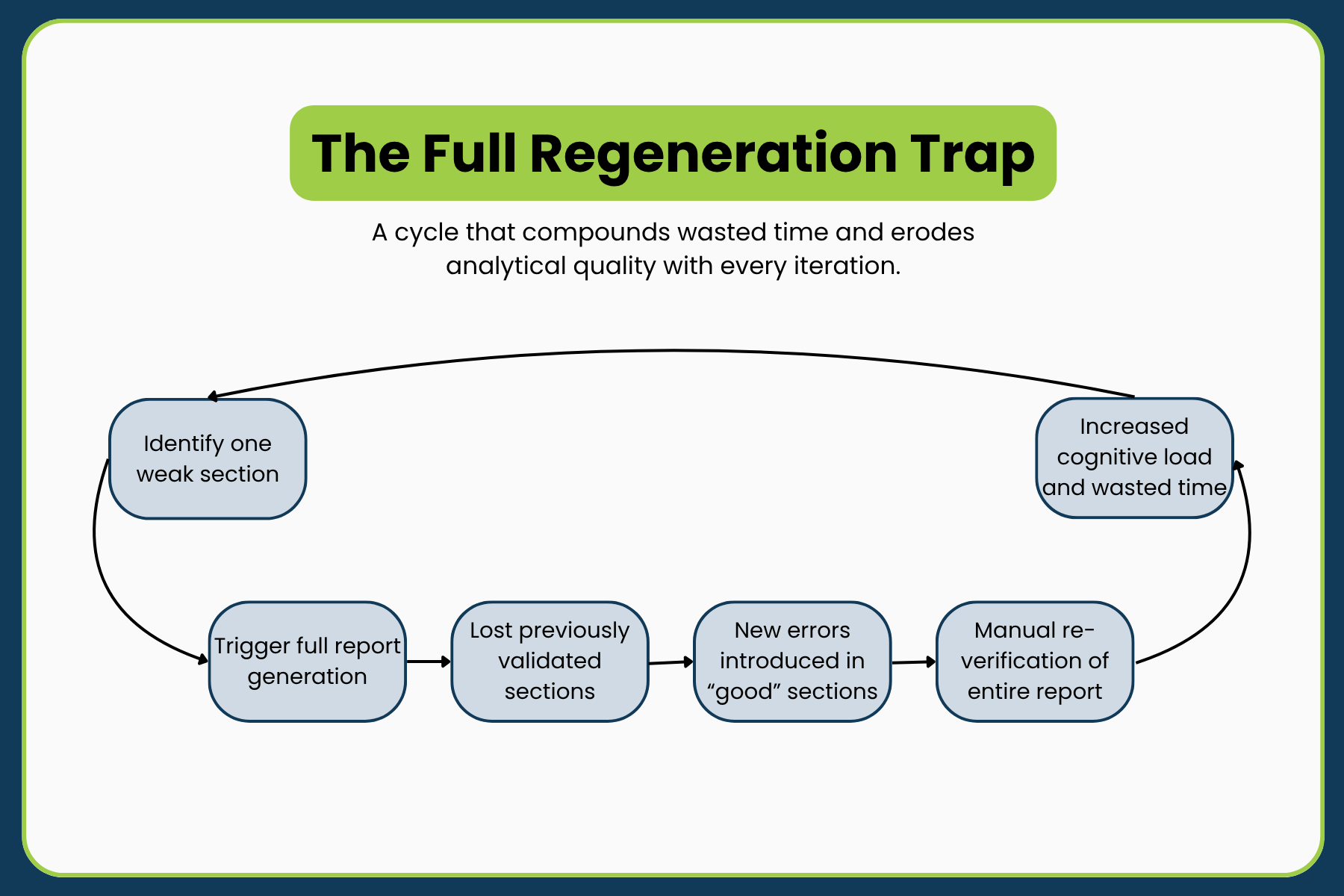
When a single weak section triggers a full report rewrite, previously validated work is lost, new errors are introduced, and the analyst is forced to re-verify everything from scratch — a cycle that compounds wasted time and erodes analytical quality with every iteration.
The Case for Section-Level Control
If full-report regeneration is a wrecking ball, section-level regeneration is a scalpel. Indago is an AI reporting platform designed for analysts who need control over what gets changed and what stays put. Indago's mission is straightforward: save analysts time while increasing the quality and defensibility of their output. You isolate what needs fixing, issue a targeted instruction, and leave everything else untouched.
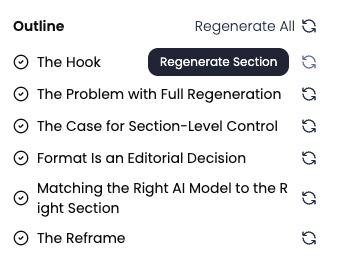
Snapshot how the section-level regeneration looks in-action.
The practical power of this approach is best understood through concrete examples. Instead of hoping a global prompt will incidentally fix one small problem, you direct the AI with surgical precision within each specific section of the report:
Narrowing Focus: You can say, "This assessment of rare earth mining is too broad. Regenerate this section to focus specifically on Chinese state-owned enterprises operating in the Bayan Obo region, and prioritize regulatory filings over news reports."
Requesting Depth: You can say, "The current TTP analysis is insufficient for our SOC team. Expand this section to include three specific examples of lateral movement observed in the raw logs, and map each technique to the MITRE ATT&CK framework."
Adjusting Analytical Lens: You can say, "Re-evaluate the risk assessment in this section. Instead of a general security lens, rewrite this as a financial risk analyst concerned with currency volatility following the central bank's announcement."
Your analytical voice accumulates through the document with every section you lock in. These are just some of the many ways you can manipulate sections within your report.
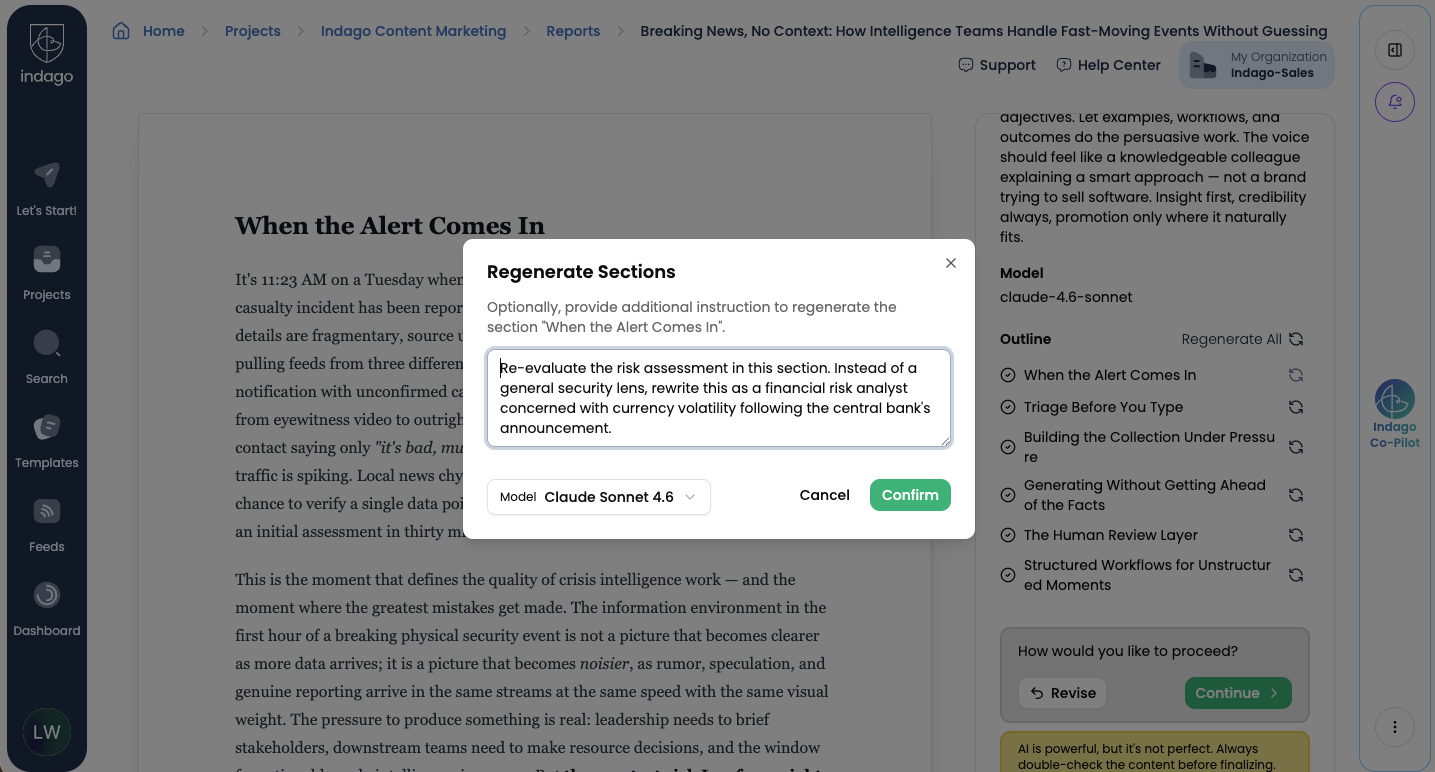
Provide in-depth edits to be applied to specific sections while creating a report in Indago.
Format Is an Editorial Decision
Format determines whether good analysis gets read or ignored. With section-level regeneration, you can fundamentally reshape the form of your analysis without touching the underlying source material.
Every experienced analyst has encountered the Bullet-Only Executive: the stakeholder who views long paragraphs as a barrier to decision-making. When your draft delivers a dense five-paragraph narrative on regional instability, a single targeted instruction handles it: "Convert this narrative into a three-point bulleted list focusing on immediate security risks." The facts stay the same.
The same logic applies to structured data. When tracking multiple threat actors or comparing regulatory shifts across jurisdictions, narrative descriptions become repetitive and hard to skim. A section-level prompt — "Turn this assessment into a table comparing the TTPs of APT29 and APT28 based on the provided sources" — synthesizes the evidence into a comparative matrix in seconds, the kind of formatting that would take an analyst hours to produce manually.
The hardest part of any report is often writing for the right reader. A technical brief for a Security Operations Center requires a fundamentally different vocabulary than a business impact memo for a Board of Directors — and for international stakeholders, the challenge extends further still. Section-level regeneration handles all of it. You can take a section dense with network logs and forensic detail and instruct: "Regenerate this section for a non-technical executive audience, focusing on business interruption and financial risk" — or "Translate and adapt this section for a French-speaking government audience."
Matching the Right AI Model to the Right Section
No single AI model is the best at everything. One may summarize crisply but miss weak signals. Another surfaces nuanced linkages but struggles with rigid structure. Selecting a single model for an entire report means accepting its weaknesses across every section.
You can assign the model best suited to each section's specific cognitive demand, turning the report editor into an orchestration layer so that you get precision where you need precision and speed where you need volume.
If a regional threat assessment feels thin, you do not hit a generic rewrite button. You trigger section-level regeneration, switch to a model known for long-context synthesis, and instruct it to deepen the analysis. The rest of the report stays exactly where you left it.

Not all sections demand the same intelligence. Assigning the right AI model to each part of your report — based on its cognitive requirements — is what separates a generic AI draft from a precision-engineered intelligence product.
Put Your Expertise Back in Command
The next time a section feels shallow or misaligned, don't regenerate the whole report. You should isolate it, choose the right model for the task, and direct the revision with a precise instruction. Your expertise is the most valuable input in the process. The AI should be working around it, not the other way around. Indago is built to put that expertise back in command.Book a demo to see what analyst-led reporting looks like in practice.