
What We've Built at Indago — And Why It Matters for Intelligence Teams

Introduction
In most intelligence shops, the paradox is stark: teams are “data‑rich but insight‑poor.” Research observing analysts under high data loads found that fragmentation and cognitive burden cause critical signals to be missed—despite best‑practice tradecraft. Meanwhile, clustered enrichment methods have been shown to reduce analyst workload by over 90%, underscoring a simple truth: the bottleneck isn’t access to data—it’s turning it into defensible insight, fast.
If you lead or staff an intelligence, security, or research function, this likely feels familiar:
Time pressure and alert fatigue collide with manual, tool‑hopping workflows. Post‑incident or daily brief products that should take minutes still take hours—or days.
Fragmented sources and inconsistent formats erode confidence and slow decisions. Analysts bounce between browser tabs, feeds, PDFs, and spreadsheets, only to retype the same sections each cycle.
Trust in AI is tentative—and for good reason. You can’t operationalize black‑box outputs, accept hallucinated citations, or ship products that won’t stand up to audit or scrutiny.
Verification is harder than ever. OSINT accuracy, bias, and provenance challenges—compounded by deepfakes and narrative manipulation—demand human judgment, traceability, and repeatable methods.
The result is a costly tradeoff between speed and rigor—exactly when both are required.
The Reality On The Ground: Data Deluge, Fragmented Tools, Trust Gaps
Intelligence teams are drowning in inputs. Multiple tabs, SIEMs, feeds, PDFs, and social streams—each with its own syntax and cognitive overhead—turn “research” into context switching. As one of our field guides notes, analysts are “data-rich but insight-poor” when workflows are fragmented and high-tempo decisions can’t wait.
Open-source environments add more friction. OSINT brings accuracy, reliability, verification, bias, and privacy challenges—especially when misinformation and manipulated media blur what’s real. Teams need speed without sacrificing rigor, provenance, or defensibility.
Indago was built to solve this exact tension: reduce manual drag, increase analytical depth, and keep the human firmly in the loop.
Our Design Philosophy: Human-In-The-Loop, Not “Hands-Off AI”
Indago’s stance is clear: AI accelerates; analysts decide.
We embed a Human-in-the-Loop model for high-stakes scenarios, with review flags, confidence cues, and analyst override. In other words, the tool assists, but the professional is accountable.
We prioritize workflow design over single-shot prompts: repeatable, auditable sequences with validation layers, not one-off “magic” answers.
We bias the platform toward source transparency, bias detection, and defensible outputs—because intelligence must be traceable, especially under scrutiny.
This approach reflects our “ethical use of GenAI” commitments: transparency, bias mitigation, and governance built into the product… not bolted on afterward.
From Prompts To Workflows: How Indago Operationalizes Analysis
Modern analysis isn’t a one-liner—it’s a sequence. Indago structures the end-to-end reporting process so analysts can move fast, think clearly, and defend conclusions.
Gather Data: Search and ingest at scale. Indago retrieves over 2.1 million results daily from 150,000+ global sources in 27 languages, and our Data Retriever plugin lets you save a snippet or a full page from Chrome/Brave without breaking flow. Upload up to 20 documents at a time across common formats to centralize your corpus.
Initialize Data: Set purpose, persona, tone, and structure once. Use templates (or your own) to standardize products—from threat briefs to compliance reports—then guide the AI with precise instructions. You can even load proven prompt patterns so the platform starts aligned to your mission.
Prepare Data: Generate a structured, editable first draft in seconds—typically 75–85% complete—then refine section-by-section. Assign specific models to each section for the best fit, isolate paragraphs, and regenerate surgically rather than rewriting the whole draft.
Generalize Data: Turn a draft into a deliverable. Built-in bias detection flags sentiment, confirmation, and selection bias across both sources and text. Inline comments and permissions keep collaboration tight—without version chaos.
Use Data: Store and reuse finished products for faster quarterly rollups, client-ready outputs, or knowledge-base building. Share securely with precise controls.
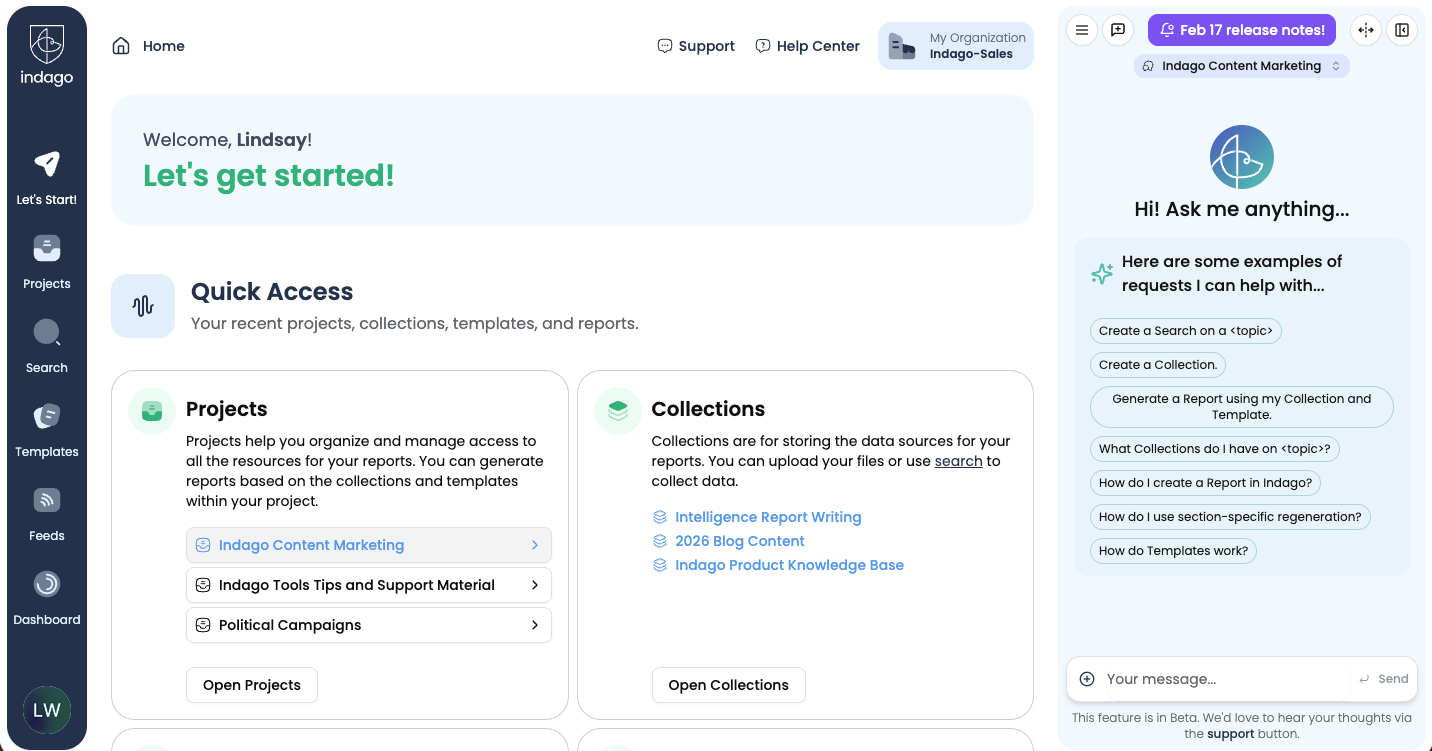
Indago’s home screen interface for users.
What This Looks Like Day-To-Day (And Why It’s Faster)
Fewer tabs, more thinking: Centralize sources, capture web intel in stride, and keep your outline stable while sections evolve under your direction.
Model control, not model roulette: Choose from 11 available models and assign them per section to balance precision, context retention, and speed.
Section-level regeneration: Fix what needs fixing—don’t nuke the document. This is how analysts protect narrative clarity while improving accuracy.
Multilingual at source and output: Search across 27 languages; draft or translate in up to 78. Keep global perspective without leaving your workflow.
Bias and misinformation safeguards: Dedicated detection layers reduce risk of slant, overreach, or unvetted claims making it into the final product.
Security, Privacy, And Control: Enterprise-Grade By Default
Indago is built for sensitive work.
Data encryption: AES-256 at rest; TLS 1.2+ in transit.
Access: Role-based controls and MFA via Clerk, following NIST guidelines.
Hosting: US-based, AWS Virtual Private Cloud with IAM and continuous monitoring.
Compliance posture: SOC 2–aligned processes and industry-standard encryption.
Data ownership: You own your data. It’s isolated per customer and not used to train the underlying LLMs.
These guardrails let teams move quickly without compromising governance or defensibility.
Results In The Field: Measurable Efficiency, Better Products
Customers report tangible gains when they adopt Indago’s workflow-first approach:
30% reduction in per-report production costs.
7+ days saved on complex report creation.
85% complete first drafts that analysts can refine rather than write from scratch.
Across use cases:
In a SOC, post-incident documentation dropped from 2+ hours to under 30 minutes, with executive-ready summaries and better compliance trails.
Corporate due diligence teams reduced production times by over 70% and standardized outputs to audit-ready formats—saving ~$2,000 per report.
Analysts at think tanks accelerated investigations by ~60%, improving editorial flow, traceability, and multilingual rigor.
Built For Analysts, Researchers, And Decision-Makers —Not Just “AI Users”
For analysts: Less cognitive load, more hypothesis testing, cleaner narratives. Section-level control ensures outputs reflect your analytic voice.
For researchers: Multilingual synthesis, bias checks, and templates for dossiers, briefs, and case files with citations preserved.
For decision-makers: Standardized, executive-ready formats with clear implications, confidence cues, and audit trails.
This isn’t “AI writing”—it’s analyst-led production, systematized.
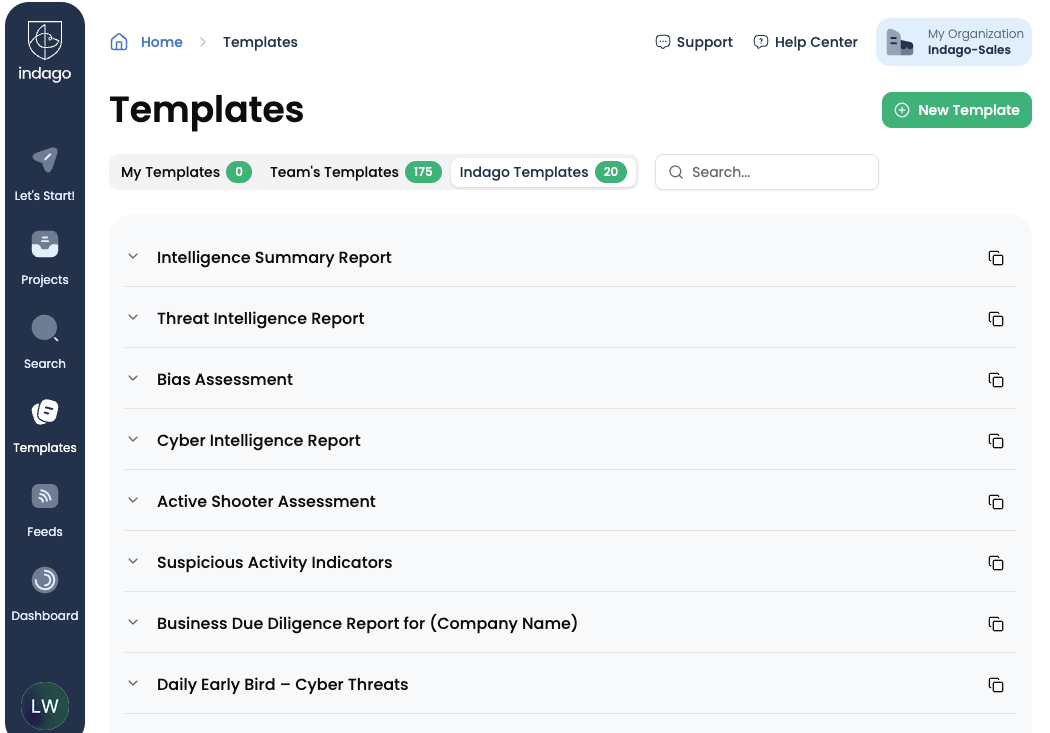
Indago’s templates help you work smarter not harder.
Compliance And Risk Teams: Legalistic, Audit-Ready Outputs
Compliance reporting demands precision and defensibility. Indago’s templates and guidance support legally sound, auditor-facing products—framing findings with objective, regulation-aligned language, assigning ownership and due dates, and cataloging supporting materials for evidence trails. The result is a consistent, repeatable methodology that holds up during internal or external review.
Analyst-First Prompting—Baked In
We equip teams with persona-based prompting, structured objectives, and repeatable formatting patterns. The platform supports:
Role/mission anchoring at the outset.
Scoped, layered prompts to avoid vague requests.
Structured outputs (lists over fragile tables when needed).
Source expansion and cross-validation to avoid narrow citation pools.
The effect: prompts that reflect analyst tradecraft, not one-off chats.
Agentic Workflows—With Guardrails
The future of OSINT and cyber intel is agentic. Our free expert guides outline how agentive browsing and task-chaining can cut through noise, correlate sources, and scale enrichment—provided you keep HITL, provenance, and attribution controls front and center. We’re building toward that future the same way we build everything else: incrementally, transparently, and with the analyst in control.
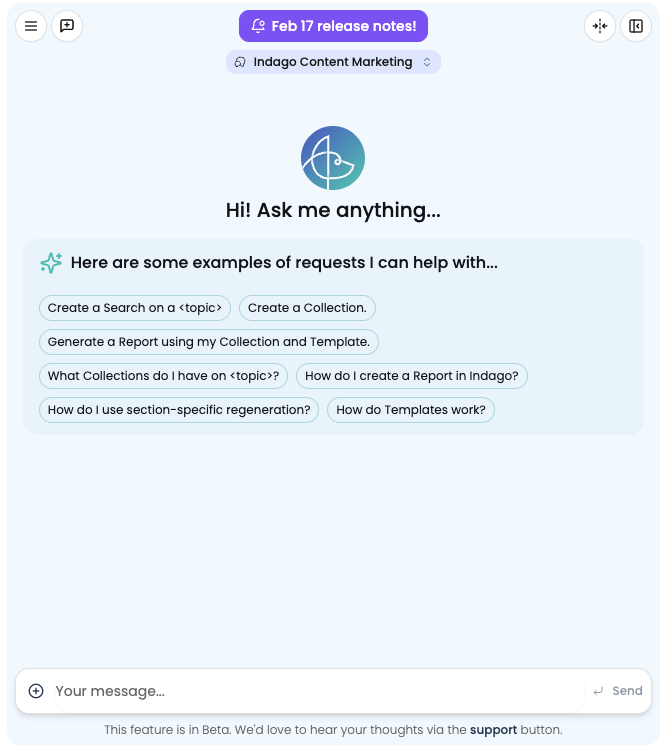
Indago’s AI Copilot helps you navigate the entire report-building process.
Why This Matters Now
The pace of information and the risks of misinformation are rising.
Teams can’t hire their way out of the volume problem—or accept black-box automation in high-stakes contexts.
The advantage goes to organizations that turn fragmented searching into governed workflows—fast, multilingual, bias-aware, and defensible.
Indago gives you that operating system for reporting—without removing the professional judgment that makes your intelligence valuable.
Key Takeaways
The problem is structural, not individual. Intelligence teams are data-rich but insight-poor—facing fragmented tools, constant time pressure, and rising mis/disinformation risks that strain trust and cognition.
Indago is analyst-first, not automation-first. Built for human-in-the-loop, workflow-driven reporting so analysts move faster without sacrificing rigor, judgment, or defensibility.
Analysts stay in control. Indago streamlines collection and drafting so teams spend more time validating sources, refining assessments, and communicating decision‑quality insight—less time on formatting and rework.
Bottom line: Indago turns the speed–insight tradeoff into a force multiplier—securely accelerating production while elevating analytical quality. Next step: see it in action with a tailored demo.
Conclusion
If you’re being asked to do more with less—faster—without compromising judgment, you’re not alone. Indago was built for exactly this moment: to give intelligence teams speed without sacrificing rigor, context, or defensibility.
What you can expect with Indago:
Faster first drafts, higher throughput: Teams routinely generate 75–85% complete drafts in minutes and report 7+ days saved per report and 30% lower production costs—freeing analysts to focus on analysis, not assembly.
Analyst-in-the-loop by design: Human oversight, structured workflows, and section-level controls keep analysts in control—shaping outputs, validating sources, and deciding what makes the cut.
Defensible, credible reporting: Built-in bias detection, citation transparency, and consistent templates support audit-ready products and stakeholder trust.
Secure, enterprise-grade foundations: AES-256 at rest, TLS 1.2+ in transit, MFA, and SOC 2 alignment—plus strict data isolation and a clear stance that your data is not used to train the underlying models.
Flexible, model-agnostic workflows: Assign the best model per section, reuse templates, and work across languages with integrated translation—so the platform adapts to your mission, not the other way around.
If you want to see how this applies to your environment—SOC post-incident reports, fusion center SITREPs, due diligence packages, crisis updates, or executive briefs—let us show you.
Book a demo to learn how Indago can accelerate your intelligence operations while preserving the standards your mission demands.