
All Articles
Filter by Category
Archive
- Tradecraft & Analyst Skills
- Productivity & Reporting
- Generative AI
- Writing & Communication
- Cyber Threats & Security
- Humans & AI
- Search & Discovery
- Help Center
- emergency response
- geopolitical
- OSINT
- Live Events
- Popular
- Templates
- Wild Dog AI Podcast
- Corporate
- Finance
- Medical
- Communication Strategy
- Politics
- Private Investigation
Cognitive Bias in Intelligence Analysis: Why a Clean-Sounding Report Can Still Be Wrong
A report can clear every check for loaded language, framing, and tone and still reach the wrong conclusion. The bias that got it there entered earlier: in which sources the analyst opened first, how fast a pattern felt confirmed, and how confidence climbed the longer they worked one thread. See where cognitive bias enters intelligence analysis, why editing-phase tools can't catch it, and three questions a reviewer can ask before sign-off.
Not Every Section of Your Report Needs Your Most Expensive Model
Most teams pick their most powerful AI model once and run every section of every report through it, including the methodology notes and formatted tables that a lighter model handles just as well. See which sections earn a premium model, which ones don't, and how choosing a model section by section can cut your token spend without lowering quality where it counts.
What Is an AI SITREP? How Teams Generate Situational Reports Automatically
Is "AI SITREP" a real category, or just ChatGPT dressed up in operational language? It's real — but the difference between the two comes down to process, not vocabulary. See what actually separates a structured, source-grounded situational report from notes pasted into a chatbot, and why that distinction matters the moment someone challenges a claim.
10 Reports Compliance Officers Can Create Faster With Indago
A finding that can't be traced to a source. A screening report with no timestamp. Two team members producing different outputs from the same research. None of these look like a crisis until a regulator asks to see the work behind the work. See how ten of the reports compliance teams produce most often — sanctions screenings, AML/KYC summaries, whistleblower investigations, and more — can be made faster and harder to challenge in an audit room.

8 Reports Executive Protection Teams Can Create Faster With Indago
EP teams are being asked to produce analyst-grade intelligence deliverables with close-protection-sized staffing. From advance threat assessments to post-incident debriefs, see what it actually takes to make eight core EP reports fast, sourced, and defensible — without adding headcount.
Tips for Fine-Tuning Report Templates in Indago
Most disappointing AI-generated reports don't have a model problem — they have a configuration problem. See how three decisions made before you click generate (persona, outline, and section-level model selection) determine whether your first draft is genuinely useful or just technically competent.

The After-Action Report Nobody Reads, & How to Fix It
Most after-action reports end up in a shared drive folder that nobody opens twice. They arrive too late, cover too much ground, and leave the reader doing the analytical work the report was supposed to do for them. This post follows Ted — an analyst who cracks the AAR problem not through better writing, but through a smarter workflow — and breaks down exactly how he produces structured, readable, actionable after-action reports in under an hour.
When AI Becomes the Source: Why Analysts Matter More Than Ever
The CNN vs. Perplexity lawsuit is about copyright on the surface. Underneath, it points to something more consequential: a growing number of professionals are consuming information through AI summaries rather than original sources. This post examines what gets lost in that compression — nuance, caveats, uncertainty, competing perspectives — and why analyst judgment has never been more important than it is right now.
Why Section-Level Regeneration Produces Better AI Reports
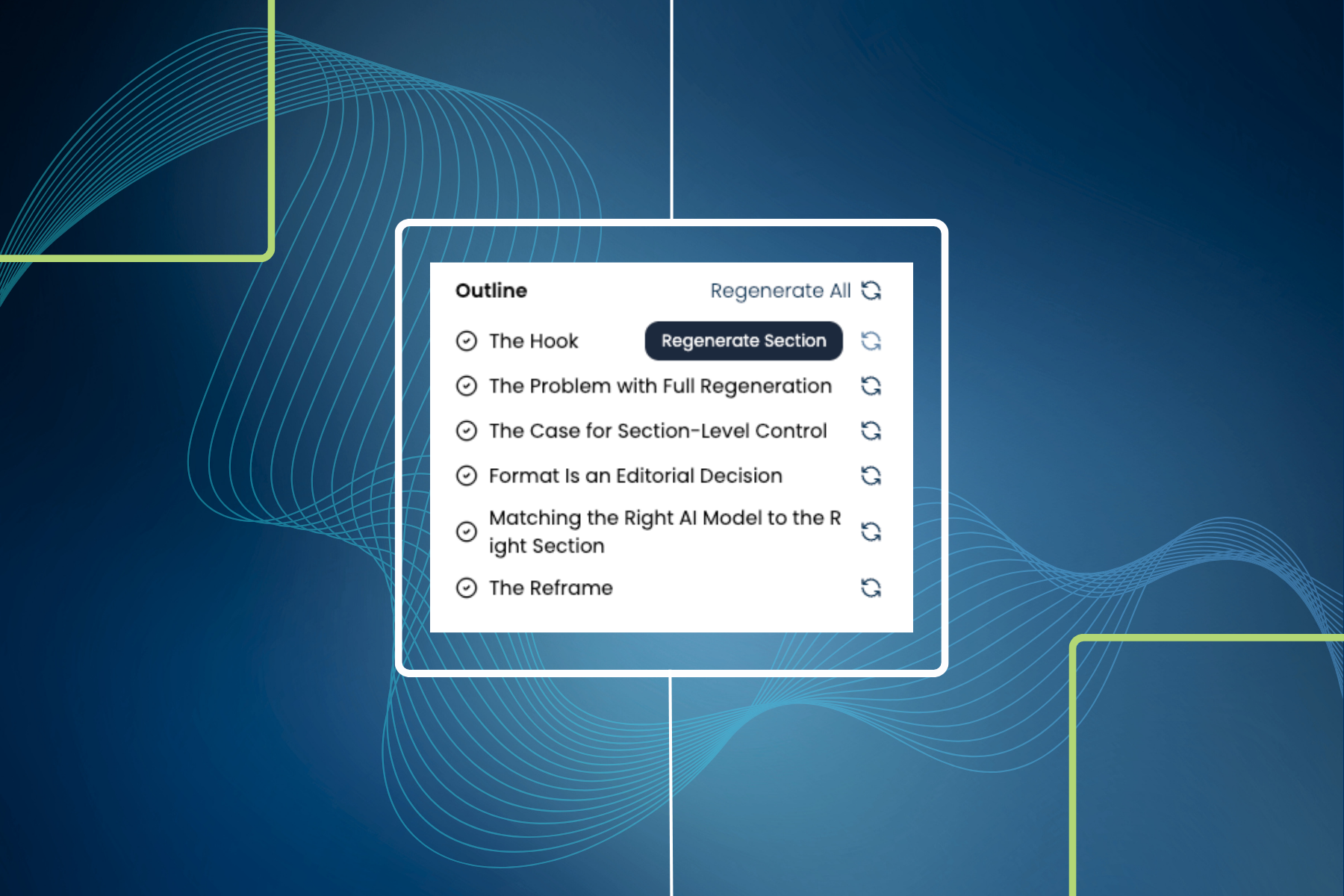
Most analysts have been there: one weak section in an otherwise solid report, and the temptation to hit regenerate and start fresh. The problem is that full regeneration treats every section as equally flawed — wiping out verified work to fix one paragraph. This post breaks down why section-level control produces better reports, how targeted instructions outperform global rewrites, and how matching the right AI model to the right section changes the quality of the final product.

How to Use Indago's Co-Pilot to Search Smarter and Draft Faster
Co-Pilot is one of Indago's most versatile features — and one of the most underutilized. This guide covers what Co-Pilot actually is, what it isn't, and how to use it effectively across three stages of the reporting workflow: searching, drafting, and editing. Whether you're translating a natural language query into a structured search, building a template from scratch, or stress-testing a draft section against your source collection, Co-Pilot is most powerful when the analyst stays in control and directs it with clear intent.
Why Intelligence Analysts Are Moving Away from Word Documents for Report Writing
Word was built for document creation — not intelligence reporting. The copy-paste sourcing workflow breaks attribution trails. Version proliferation creates invisible coordination failures. Formatting overhead eats analyst time that should go toward analysis. And when a report is finalized, the reasoning behind it disappears with the analyst who wrote it. This piece breaks down the four structural failure points of the Word-based reporting workflow and what a purpose-built alternative actually looks like.
Intelligence Report vs. Intelligence Brief: What's the Difference and When Do You Use Each?
Intelligence reports and executive briefs serve fundamentally different purposes, but many analysts default to one format out of habit rather than choosing based on what the situation actually requires. This guide defines both formats clearly, breaks down the key distinctions across audience, purpose, length, and structure, and gives analysts a four-question decision framework for choosing the right one every time. It also covers a workflow approach in Indago that lets you produce both formats simultaneously from the same source collection — no duplicate work required.
How to Build Your First Intelligence Report in Indago: A Step-by-Step Walkthrough
Building your first intelligence report in Indago comes down to a series of clear, manageable decisions. This walkthrough shows exactly how to move from source selection to a structured, fully sourced draft, then refine it into a finished report. You’ll see how templates, models, and editing tools fit together in a real workflow. By the end, you’ll know what to do at every step.
Can AI Be Trusted for OSINT? Bias, Hallucinations, and Verification Methods Explained
AI hallucinations occur when language models generate information that sounds authoritative and well-sourced but has no basis in reality.
Indago’s built-in bias detection flags these patterns in generated text before they reach a finished report. It identifies patterns that suggest sentiment bias, confirmation bias, or selection bias, alerting analysts to sections that may require additional scrutiny.

Briefing the Boss: Turning Raw Findings into Executive-Ready Reports Without Rewriting Everything
Most analysts don't have a research problem… they have a last mile problem. The analysis gets done in hours; the reformatting to match a boss's specific preferences takes just as long.
This piece walks through five of the most common stakeholder quirks analysts deal with, and how to encode those preferences directly into your Indago report templates so every report starts from the right place instead of a blank page.

Multilingual OSINT in Practice: How Analysts Work Across Languages Without Translation Bottlenecks
Analysts across government agencies, private intelligence firms, and corporate security teams face a persistent operational challenge: critical intelligence signals frequently emerge first in local-language media, hours or even days before appearing in English-language outlets that dominate traditional OSINT workflows.
Modern OSINT investigations require analysts to monitor foreign media narratives, identify emerging regional dynamics, and validate information across multiple languages simultaneously.

1 Incident, 3 Reports: How Analysts Create Tailored Reports for SOC, Executives, and Legal in Under an Hour
A single cyber incident rarely needs one report — it needs three: the SOC wants IOCs now, executives want risk clarity, and legal wants defensible documentation. See how one analyst turns the same dataset into three audience-specific briefings in under an hour using structured workflows instead of hours of rewriting.

Bias Detection in Intelligence Reporting: What Tools Can (& Can’t) Catch
In an era where generative AI can both accelerate drafting and amplify error, the invisible risk is not a missing footnote; it’s the bias you don’t catch. Indago approaches this problem in practice: a workflow‑first platform with a built-in bias detection model that flags potential sentiment, confirmation, and selection bias in sources and report text.

Humans & AI: How Indago Helps Analysts Focus on What Matters Most
Discover how Indago’s generative AI transforms intelligence reporting, freeing analysts to focus on strategic insights. Streamline data collection, automate report drafting, and produce high-quality intelligence faster—without sacrificing expertise. From daily cyber briefs to in-depth situation reports, Indago empowers analysts to work smarter, not harder.

Navigating the Mirage: The Rise of Misinformation in the Digital Age
Explore the complex landscape of misinformation in today’s digital era in our latest blog. From the deepening impact of generative AI on public discourse to the crucial role of media literacy, uncover how technologies shape our understanding of truth and democracy. Dive into effective strategies for combating misinformation and strengthening societal resilence.