
What Makes a Modern Intelligence Reporting Platform (& Why Legacy Tools Fall Short)
You know the grind: keyword searches across countless tabs, manual copy-paste into static documents, ad‑hoc prompts to a black‑box LLM, and hours lost to formatting—only to deliver a product that’s hard to reproduce, defend, or audit.
Meanwhile, misinformation risks escalate and stakeholders demand transparency, bias checks, and audit trails. The result is a recurring tradeoff between velocity and verifiability—precisely where traditional tools and document‑centric processes fall short.
From Tools To Workflows: Why Legacy Stacks Stall
Most “stacks” for intelligence reporting evolved as a pile of point tools—search, translation, note-taking, formatting—stitched together by copy/paste and personal habits.
That model may have made sense when volume and tempo were manageable, but today, the data deluge is an operational risk. Analysts lose time tab-hopping, reformatting, and revalidating the same facts. Cognitive load rises, traceability drops, and speed becomes the enemy of rigor. Not to mention, siloed tools don’t remember context, static PDFs can’t adapt, and provenance often gets lost in the handoffs.
Ad‑hoc prompting in a chat window doesn’t solve this either. It can accelerate drafting, but without guardrails (source traceability, bias checks, HITL), outputs are hard to defend and difficult to reuse.
What Modern Platforms Do Differently
What your team needs to succeed in today’s data-heavy, speed-oriented environment is a modern intelligence reporting platform that prioritizes efficient workflow and:
Orchestrates collection, synthesis, validation, and packaging as one flow.
Embeds human‑in‑the‑loop (HITL) oversight at decision points.
Grounds content in multi‑source evidence with transparent sourcing.
Surfaces and mitigates bias in sources and text.
Produces defensible outputs—auditable, repeatable, and exportable.
Operates with enterprise security controls and data governance.
These characteristics reduce rework, cut cycle time, and raise the floor on product quality.
That’s exactly what we’ve created here with Indago. It’s a true example of this workflow-first approach. It doesn’t replace analysts; it accelerates them while preserving control.
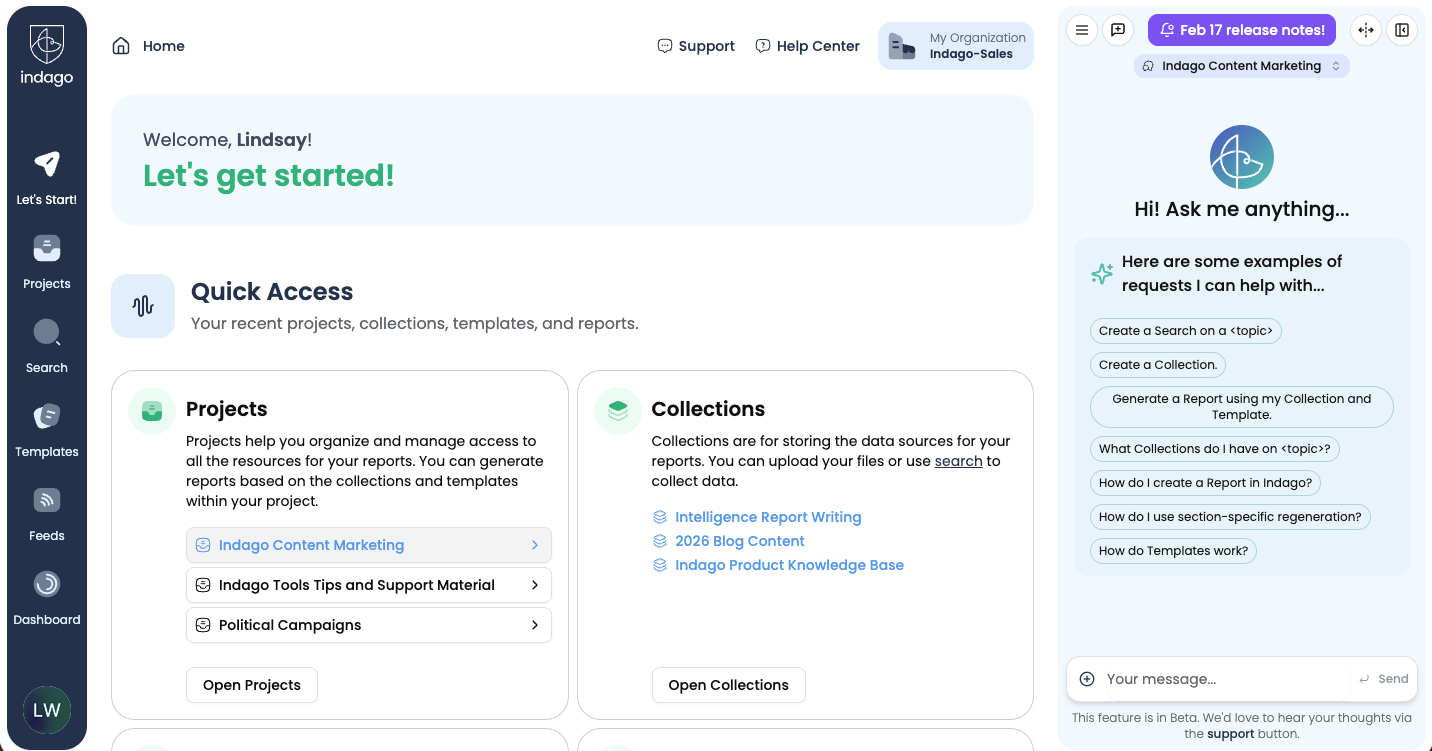
Indago’s home page interface for users.
Key features:
Gather Data: Pull open sources at scale—Indago retrieves over 2.1 million results daily from 150,000+ global sources across 27 languages. Add content via a Chrome/Brave Data Retriever, and upload your own files (supporting diverse formats, up to 20 at a time) so proprietary and public inputs live together.
Initialize Data: Define purpose, role, tone, citations, and structure with reusable templates. Fine‑tune prompts and outlines to match product types—threat briefs, policy memos, SITREPs—so every draft starts on‑spec.
Prepare Data: Generate an initial draft in seconds, typically 75–85% complete. Assign specific models per section for optimal results, and regenerate at the paragraph or section level without redoing the whole product. Use integrated translation to draft in 78 languages and analyze multi‑language sources.
Generalize Data (Validate & Polish): Run Indago’s built‑in bias detection on sources and prose to flag sentiment, selection, or framing issues. Edit in-platform, embed visuals, and standardize formatting. Collaborate in real time with comments and permissions.
Use Data: Save reports to collections for trend tracking and reuse; export and share securely with role‑based access. Teams maintain continuity and reduce reinvention in weekly, monthly, or ad‑hoc cycles.
Security & Governance: AES‑256 at rest, TLS 1.2+ in transit, MFA, and SOC 2 alignment. Data resides in a VPC with IAM controls, and customer content isn’t used to train underlying models. Admins manage access and permissions to enforce least privilege.
Integrations & APIs: Enterprise integrations and API access are available to bring internal feeds or third‑party data into the same reporting surface, enabling real‑time fusion with auditability.
Clients who use Indago in their daily workflow report:
Shorter cycle times (e.g., 7+ days saved for complex products)
Drafts that arrive 85% complete
Material cost reductions per report—while maintaining analyst oversight.
HITL and Defensibility—By Design, Not Aspiration
Human oversight isn’t a checkbox–especially at Indago. It’s the mechanism that keeps speed aligned to consequence and the necessary finishing step to creating a quality, trustworthy report. Reports transform from “looks right” into “stands up under scrutiny” when analysts:
Use HITL where subjectivity or stakes are high—political sentiment, legal exposure, escalatory scenarios.
Pair confidence cues with review flags so analysts know what must be checked.
Preserve rationale with action logs and sourcing so reviewers can audit what happened, when, and why.
Why Ad‑Hoc AI Isn’t Enough
Prompts help; workflows scale. Moving from “ask once, hope for the best” to modular flows (ingest → translate → extract → compare → validate → draft → review) increases consistency, reduces bias drift, and makes performance repeatable across teams.
Modern platforms also decouple tasks from models. Fast models triage; higher‑precision models finalize. That keeps cost, latency, and quality in balance.
Today’s intelligence work doesn’t need one-off shortcuts and occasionally faster document creation—it requires a standardized, governed workflow that is seamlessly engrained in your analysts' day-to-day operations. Platforms that systematize tradecraft, expose provenance, and keep analysts in control will outpace ad‑hoc tooling as volume, velocity, and scrutiny continue to rise.
Conclusion
Modern intelligence work demands more than stitched‑together tools and static documents. It requires a workflow‑driven platform with human‑in‑the‑loop controls, multi‑source synthesis, and transparent, defensible outputs. Indago was built for that reality—combining secure AI, structured templates, section‑level model control, and built‑in bias checks to help analysts move faster without sacrificing rigor.
Teams using Indago report measurable improvements—AI‑generated first drafts that are 75–85% complete, 7+ days saved on complex products, and roughly 30% reductions in per‑report production costs—while keeping analysts firmly in control.
The platform is engineered for trust: data encryption (AES‑256 at rest; TLS 1.2+ in transit), SOC 2 alignment, customer data isolation, and a clear commitment that customer data is not used to train foundation models. Multilingual search (27 languages) and generation (up to 78 languages), audit‑ready outputs, and collaboration features ensure products are consistent, source‑aware, and ready for scrutiny.
If you want to see what a modern, defensible reporting workflow looks like in practice, sign up for a demo. You’ll see how Indago helps you:
Apply reusable, role‑aligned templates that produce consistent, source‑cited drafts in minutes.
Assign the best AI model per section for precision, context retention, or speed.
Use a purpose‑built bias detection model to flag sentiment, selection, and confirmation bias.
Maintain audit trails, metadata, and traceability suitable for compliance and external review.
Work securely with team permissions, inline comments, and section‑level regeneration.
Operate globally with integrated translation and multilingual search.