
What Is an AI SITREP? How Teams Generate Situational Reports Automatically
The Term You Keep Seeing Explained
If you searched AI SITREP or SITREP AI, you had a reasonable suspicion: is this a real category, or just ChatGPT wrapped in operational vocabulary? It's a real thing that existed long before Chat existed.
A SITREP (short for Situation Report) is a concise, structured summary of current events, ongoing operations, or status updates. An AI SITREP is a structured, end-to-end workflow covering AI-assisted collection, synthesis, drafting, and distribution of a Situation Report.
If you already know the format, the 30-Minute SITREP guide is your next stop. If you still want to learn more about it, keep reading.
What a SITREP Actually Is (And Where It Comes From)
A situational report gives decision-makers a structured, current picture of what is happening and what it means for their next move.
The format originated in military and intelligence operations, where standardized updates had to move quickly up command chains without losing critical context. That structural discipline — clear sections, defined purpose, consistent delivery — proved so effective at reducing decision lag that business adopted it across nearly every function operating under time pressure, such as:
Communications & PR teams tracking breaking issues or reputational events
Operations & Incident Response teams coordinating during outages or disruptions
Competitive Intelligence teams monitoring market movements and competitor activity
Strategy & Policy teams watching regulatory or geopolitical shifts
What separates a situational report from a Slack thread or a forwarded email is repeatability and structure. Every reader gets the same clear picture and nothing critical drops out.
Why "AI SITREP" Is a Category, Not a Feature
The term AI SITREP gets used two ways: loosely, as a description of pasting notes into ChatGPT and prompting it to produce something SITREP-shaped; and structurally, as a deliberate operational pipeline from intel to report. The difference between those two uses determines whether your output is trustworthy or just fast.
The ad hoc approach fails at scale for three reasons:
No Source Control: the model works from whatever you copied in, with no record of provenance or capture date.
No Repeatability: a different analyst running the same prompt gets a different output, formatted differently, weighted differently.
No Defensibility: when a stakeholder asks where a claim came from, there is no audit trail to consult.
Automated intelligence reporting as a category shifts focus from the AI model to the process surrounding it. An AI SITREP, properly defined, is an end-to-end pipeline for situational report automation — one where source curation, synthesis logic, drafting parameters, and output formatting are all deliberate and documented. The AI accelerates each stage, but the structure makes results defensible.
That pipeline runs through four stages — collection, synthesis, drafting, and distribution — each one closing a hole that ad hoc generation leaves open.
The 4-Part Process Behind Every Real AI SITREP
Real situational report automation is a four-stage pipeline where each stage depends on the integrity of the last. Collapse any one of them and the output is compromised.
Collection: Where Report Quality Is Actually Decided
Quality is determined before writing begins. Collection is the deliberate act of curating and validating the sources that will serve as the report's evidentiary foundation. A defined source universe means specifying which feeds, documents, publications, or databases are authoritative for the topic at hand, and consciously excluding everything else.
Platforms like Indago operationalize this through Collections, where every source an analyst adds is captured with full attribution — publication, URL, timestamp, author. The AI works exclusively from within that bounded set; it does not pull in unreviewed content from the open internet, which is what separates verifiable output from speculative output and substantially reduces the hallucination risk.
Synthesis: Why Cross-Source Analysis Beats One-Shot Summarization
Synthesis is not summarization. Summarizing a single document is a clerical task. Synthesis means connecting signals across multiple sources — identifying where accounts converge, where they diverge, what patterns emerge across time or geography, and what holes the available evidence leaves unfilled.
The biggest risk in automated intelligence reporting shows up when a narrow or one-sided set of sources produces a conclusion that sounds confident but isn't actually solid. Indago's cross-source synthesis works across the full breadth of an analyst's curated collection, sparing the analyst from the invisible risk of building conclusions on whichever source happened to surface first. The platform surfaces relationships that time pressure would otherwise obscure, and the analyst still supplies the interpretation no platform can provide.
Drafting: Structure Before the First Word
A real AI SITREP draft is generated from a defined purpose, a structured outline, and a bounded source set — all configured before generation begins. This is the architectural distinction that separates an AI SITREP from generic LLM output, where structure is inferred from a conversational prompt and the result reflects whatever the model decides a SITREP should look like.
Indago's template-driven approach makes this concrete: purpose, intended audience, and section structure are configured upfront. The resulting draft arrives with inline citations tied directly to the source documents in the collection, so any claim can be traced without reconstructing the research from scratch. When one section needs revision, it can be regenerated in isolation without disturbing the surrounding analysis.
Distribution: Audience-Ready Output, Every Cycle
Distribution means producing output that is immediately audience-ready and being able to repeat that tomorrow without rebuilding the workflow from scratch. A well-drafted, fully sourced report that requires two hours of reformatting before it reaches its audience is not a finished product… it is a draft with extra steps.
The analyst who ran Monday's brief should not have to reconstruct the architecture on Friday. Indago's reusable templates and export-ready outputs mean the formatting logic, audience calibration, and section structure persist across reporting cycles. Different recipients — a technical operations team, a senior executive, an external partner — receive appropriately formatted versions of the same underlying analysis without requiring the analyst to start over each time. That repeatability is what turns real-time SITREP generation from a one-off capability into a sustainable operational practice your team can actually depend on.
AI SITREP vs. Just Using ChatGPT: What's the Difference?
The difference between the two approaches becomes obvious the moment a stakeholder challenges a specific claim and the analyst can't point to where it came from.
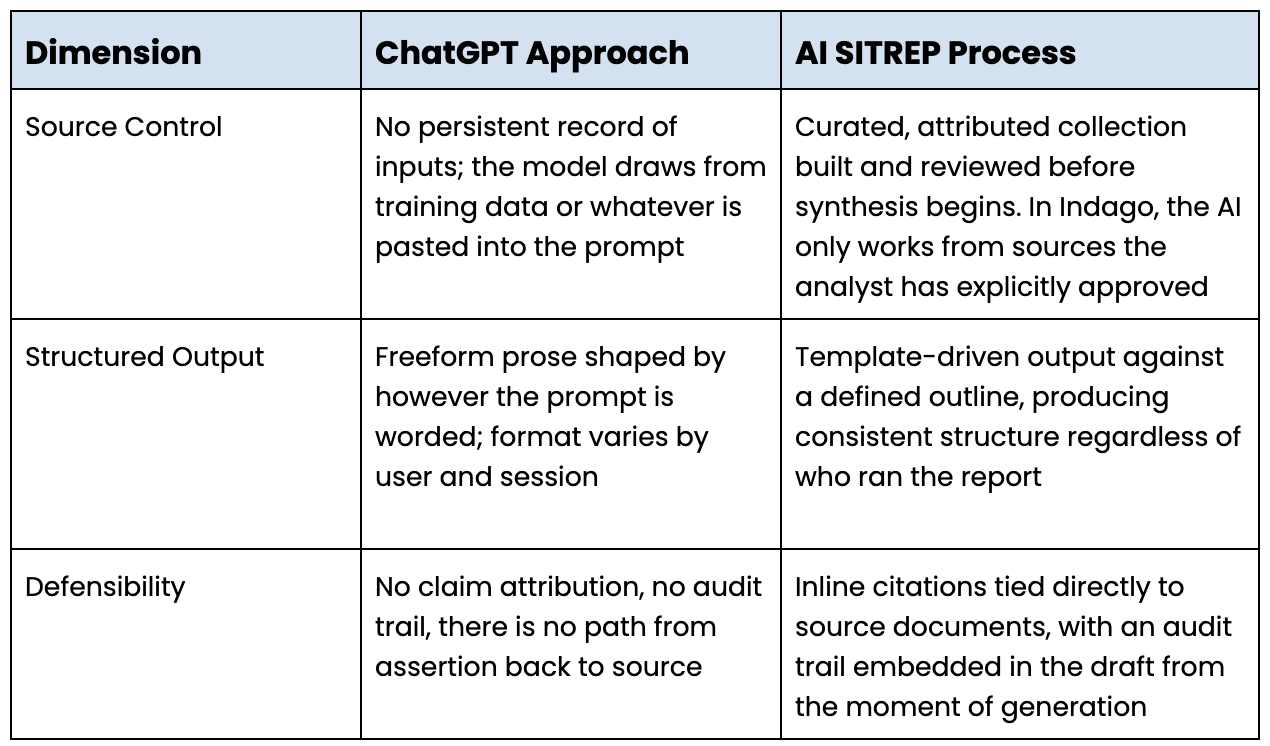
Speed and surface formatting can be approximated with a general-purpose LLM, but when a stakeholder challenges a finding and you can't trace it back to a source, the report's credibility collapses. That's exactly what automated intelligence reporting is built to prevent.
Which Teams Are Already Doing This
If your team produces any kind of recurring status update—a weekly competitive brief, a morning ops summary, a real-time incident log—you're already doing a version of situational report automation. The structured AI SITREP is simply what that process looks like when it's repeatable, sourced, and defensible.
Communications & PR — These teams use SITREP AI to monitor developing news cycles and brief leadership before a story reaches critical momentum. Without that structured lead time, communications leaders walk into press calls reacting instead of directing.
Competitive Intelligence — CI functions run recurring SITREPs on competitor activity, pricing signals, and market shifts without rebuilding the collection logic each cycle. The analyst stops spending Tuesday morning re-pulling sources they pulled last Tuesday.
Operations & Incident Response — SOC analysts and crisis managers depend on a continuously updated shared picture as conditions shift by the hour. When that picture is fragmented across tools and inboxes, responders on different shifts make decisions from different versions of reality.
Strategy & Research — These groups synthesize signals across geographies and verticals into a consistent executive brief. Leadership gets a structured document they can annotate, escalate, and act on—rather than a summary they have to interrogate for sourcing.
Policy & Regulatory Affairs — These teams track legislative developments and enforcement actions across jurisdictions in a format already structured for senior review. Traceable sourcing means that when legal asks where a claim came from, the answer is already in the document.
If your workflow maps to any of these, the next section shows where the full process lives.
See the Process in Action
You now understand what a real AI SITREP is. The question is whether your team is running a structured pipeline or improvising around one every time a tasking lands.
Your analysts shouldn't have to stitch together a new workflow from scratch every time leadership needs a defensible, repeatable situational report. Indago is where real-time SITREP generation at scale is fully operationalized.
Every step built in, not bolted on.
Book a demo and bring a real use case — we'll run the full pipeline on your actual sources.