
The True Token Cost in AI-Assisted Intelligence
The Hidden Cost of "Just Regenerate It" in AI Report Generation
A report is nearly finished. All nine sections are drafted, the analyst has validated the sourcing, and a colleague has signed off on the executive summary. Then a new source arrives that bears on section four. The fastest option is to add it, regenerate the draft, and send it.
However, that option carries two costs. The first is tokens: AI models process text in tokens, and the text a model generates is typically the more expensive side of that exchange. Regenerating the whole document produces every section's output again, including the eight sections nobody asked to change.
The second cost falls on the analyst. A regenerated section is new text, even when it reads the same as before. The analyst has to check it again, so work that was already approved returns to the review queue.
Regeneration scope, meaning how much of a report the model rewrites each time something changes, sets both the token bill and the review workload. We’ll walk through a nine-section example report to put numbers on that difference, and a workflow built on saved templates, Collections, and section-level regeneration shows how to keep the rewrite to the section that changed. This post is written for analysts managing revision cycles and team leads watching turnaround and cost.
How Full-Document Regeneration Works & Where AI Token Cost Adds Up
A token is a chunk of text, roughly three-quarters of a word. Every model interaction has two sides: input tokens, which are what the model reads, and output tokens, which are what it writes.
Output tokens cost more. One major model provider's published API pricing lists them at several times the input rate across its current models, so the text a model generates is the larger cost variable. Exact figures vary by provider and model.
Prompt caching can lower the input side. When an identical prompt prefix is re-sent, a cache hit avoids reprocessing it. Caching applies to what goes in, and the model still produces its output fresh each time.
When an analyst regenerates the entire report, the model writes all nine sections again, including the background, the methodology, and the executive summary, whether or not the new source touched them. If one section needed updating, the other eight still produce output, and that output is paid for a second time. And the amount of text generated grows with each revision.
What Happens to Approved Text When AI Rewrites the Whole Report
A full regeneration also affects the sections the analyst already approved. The model produces new output for every section, informed by the updated prompt and sources, and does not copy what it wrote before. Differences between versions may be small, and any change in a validated section, even a single sentence in an approved conclusion, requires the analyst back to recheck it.
A 2026 preprint, LLMs Corrupt Your Documents When You Delegate (Laban, Schnabel, and Neville), tested 19 models across 52 professional domains and found errors that were sparse but severe and that compounded as workflows grew longer. The study examines extended multi-step document editing and does not measure a single regeneration, so it applies most to teams that regenerate often: each additional pass is another opportunity for settled text to shift.
A second study, LLMs Get Lost in Multi-Turn Conversation (Laban et al., 2025), compared single-turn and multi-turn prompting across six generation tasks. Performance fell by an average of 39% in multi-turn conversations, and the authors attribute most of the decline to a rise in unreliability.
For human-in-the-loop AI review to hold up, the analyst needs to know which text changed. A full-document rewrite makes that hard to see. A sound AI draft revision workflow keeps untouched sections out of the rewrite, so the reviewer checks new material and spends no effort hunting for silent changes.
A Worked Example: One New Source, Nine Sections
The figures below are an illustration built on stated assumptions. They do not reflect any platform's billing.
Assumptions:
A finished report has nine sections of roughly 250 words each, about 2,250 words in total.
Output is estimated at 0.75 words per token, which puts the full report at roughly 3,000 output tokens.
A single section regenerates at roughly 330 output tokens.
Each revision is triggered by a new source that affects one section.
Input tokens, reasoning tokens, caching behavior, and per-model pricing vary by workflow and are excluded.
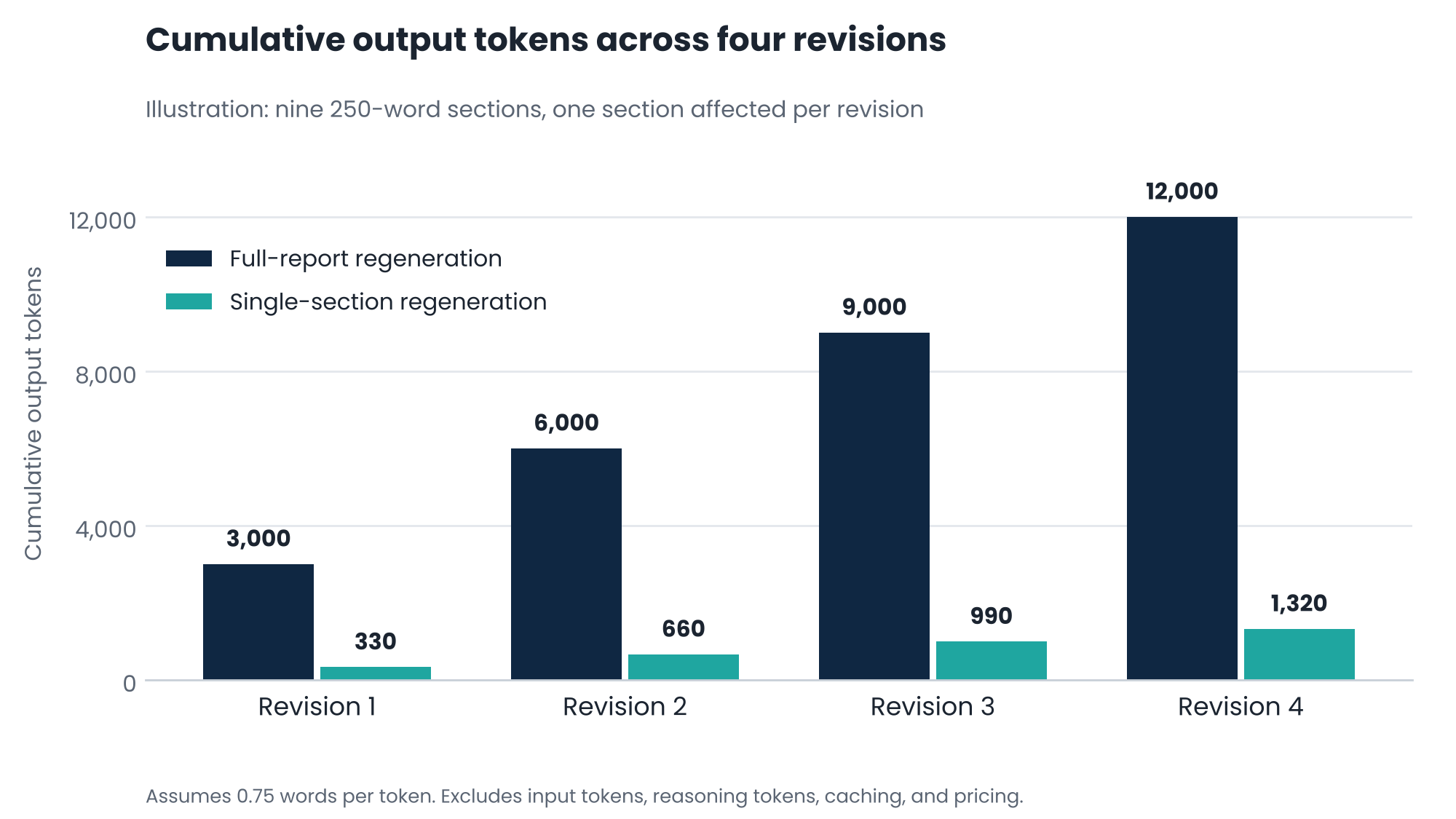
Say the new source affects the threat actor profile. In the full-rewrite scenario, the analyst re-prompts the entire draft, and all nine sections are generated again, including the executive summary that was already approved and the methodology note that has not changed.
With section-level regeneration, only the threat actor profile is rewritten, and the other eight sections stay as they were. Output volume follows the scope of the regeneration.
Review effort follows the same pattern. After a full regeneration, the analyst has nine sections to recheck, any of which could differ from the prior version. After a targeted one, the analyst reviews just one section. By the fourth revision, that is 36 section reviews in the full-rewrite workflow and 4 in the targeted one.
A dollar figure would depend on the model and on how a given system counts input and output. The example shows that regeneration scope is a variable the team can control.
Section-Level Regeneration: Revising Only What Changed
Section-level regeneration happens while the analyst is still shaping the draft. The analyst selects the section that needs work, adds an instruction, and regenerates that section alone. The rest of the report stays as written, and the section is revised from the sources the report started with, using the same Collection as the original draft.
Because the other eight sections are untouched, the analyst's review of them stays valid, and the revised section is the only one that needs a fresh look. The analyst can also choose a different model for that section without changing how the rest of the report was produced.
Once the draft reaches the editing stage, teammates can comment inline, and further changes to a section are made with the co-pilot.
Templates & Collections: Set the Structure Before the First Draft
One way to reduce how often a report gets regenerated is to settle the structure before the first draft exists.
A saved template stores the section outline with its citation instructions, the persona that defines the intended reader, and a default model. The analyst makes these choices once, and each new report starts from them.
A Collection holds the sources. The analyst adds news and media articles found through Search, uploaded documents, page text saved with the browser plug-in, RSS feeds, and API integrations, and nothing enters the Collection unless the analyst adds it. The draft cites those sources, and the analyst verifies each claim against them.
A first draft built from a defined outline and a curated source set is about 75 to 85% complete. It arrives structured and cited, ready for the analyst to read critically, validate, and refine. With the structure settled up front, a team can need fewer rounds of regeneration and fewer sections to re-verify.
Human-in-the-Loop AI Review: Where the Analyst's Time Goes
Faster drafting shifts effort toward review. The analyst still chooses the sources, validates every claim against them, and decides what stays in the final draft. AI produces the draft, and the analyst owns the conclusions.
Commentary from researchers at Victoria University of Wellington describes this pattern: as AI tools generate content faster, expert reviewers carry a heavier share of the checking, and the reviewer who signs off holds the accountability for everything underneath. Their conclusion is that oversight has to be designed in and budgeted for.
Section-level regeneration is one way to build that in. A full rewrite resets the analyst's review across the whole document, and a single-section regeneration keeps the review proportional to what changed.
We covered a related finding in AI Was Supposed to Save Time. Why Are Teams Busier Than Ever?: when AI speeds up one stage of work, the workload often expands to fill the gain.
Build a Draft Revision Workflow Your Team Can Reuse
Three decisions made before the next round of revisions keep the process manageable.
Save the outline as a template. Store the section structure, citation instructions, persona, and default model, so every draft starts from the same foundation.
Gather sources in a Collection before generating. The analyst selects what goes in, and the draft cites that selection.
Regenerate by section when new sources arrive. Identify the section the new material affects, add the source to the Collection, and regenerate that section. Approved sections stay as written.
That is the full loop: structure first, sources second, targeted revision third. To see how it works with your team's own reports, book a demo.