
The Question Isn't Whether AI Wrote It—It's Whether You Can Defend It
AI Detectors Are Measuring the Wrong Thing
A publisher recently dropped a $2 million book deal over an AI writing accusation backed by a detector score. A Yale student sued after a professor used GPTZero to flag his exam. An Adelphi University student won a lawsuit after being penalized on the basis of Turnitin's output. In each case, the detector was treated as evidence — evidence built on methodology shakier than anyone admitted.
As The Verge reported in August 2026, AI detection tools don't agree with each other, can't achieve consistent accuracy across writers, and are known to disproportionately flag non-native English speakers and neurodivergent writers. Turnitin acknowledges its tool "may not always be accurate." GPTZero warns that "no AI detector can ever truly be 100% perfect." OpenAI shut down its own detector due to low accuracy. MIT states flatly that "AI detectors don't work." Yet these tools are now embedded in academic platforms, publishing pipelines, and increasingly, professional review processes.
The tools aren't just unreliable — they're asking the wrong question. Compliance teams, consulting firms, and intelligence units are already facing the same demand: prove AI didn't write this. Did AI touch this? is a question about authorship attribution. Can you defend this? is a question about professional rigor. For intelligence analysts, risk consultants, compliance officers, and security professionals, only one of those questions actually matters when a client, regulator, or leadership team pushes back on your work.
The 4 Pillars of a Defensible AI-Assisted Report
The same four principles determine whether an AI-assisted work product can withstand professional scrutiny, regardless of which tool you use:
Source provenance: every claim in a defensible report must trace back to a specific, reviewable source, like an actual document a qualified person selected and approved. If you can’t identify where a finding came from, you cannot defend it.
Human direction: the analyst, not the model, must define the report's purpose, audience, structure, and analytical framing before generation begins. A report shaped by deliberate human instruction is fundamentally different from one produced by an open-ended prompt: it reflects professional judgment instead of the model's best guess at what a report should look like.
Human review: an AI’s output is a starting draft, never the finished product. A defensible workflow includes at least one qualified person reading the output critically, challenging its claims against the source material, and modifying anything that doesn't hold up. Section-by-section scrutiny is more rigorous, and more defensible, than a single pass over the whole document.
Accountability: someone must put their name on the report and be prepared to brief it, defend it, and answer for it. Without a named human owner, there's no professional standard being upheld, no matter how polished the output looks.
Most AI workflows that fail all four pillars fail for the same reason: the process started at generation instead of before it.
Why Most AI Reporting Workflows Fail This Test
Here's the dominant pattern of AI use in professional settings: open ChatGPT, type a prompt, read the output, paste it into a deliverable. This workflow fails all four defensibility pillars structurally. Every experienced analyst's skepticism about AI-assisted work traces back to watching this exact pattern play out.
Source provenance is gone because the model draws from everything it was trained on, a mix of reliable and unreliable material that it can’t distinguish between. Human direction never happened because the structure and purpose emerged from a vague prompt instead of deliberate instruction. Human review is hollow because fluent output creates a false sense of completeness — polished prose reads as validated even when it isn't. And accountability collapses last: the analyst can't trace a contested claim back to a source.
Hallucinations are the most visible symptom — fabricated statistics and non-existent citations surfacing with the same confident tone as verified facts. But that's an argument against unstructured AI use, not against AI itself. The real problem is the absence of workflow controls that would catch those errors before they reach a stakeholder.
A quick read-through at the end doesn't fix any of this. Defensibility has to be built into the process before generation begins, and that starts with a decision most AI workflows skip entirely: controlling what the model is allowed to see, and who gets to make that call.
How Indago Puts the Human in Front of the Model
The fundamental failure of most AI reporting workflows is structural: the model decides what goes in. Indago is built around a different premise: the analyst decides what the model sees before generation begins.
Every Indago report starts with a Collection—a curated set of sources the analyst has explicitly selected, reviewed, and chosen to include. The model cannot browse the open internet, draw from its training data, or introduce sources the analyst hasn't approved. It can only synthesize from what's inside that Collection. In practice, analysts build Collections from Indago's indexed database of over 140,000 vetted global sources, web content captured via the Data Retriever extension, or proprietary documents uploaded directly — a deliberate sourcing decision made before the model writes a single word. That's how you actually stop hallucinations altogether — not just make them less likely.
Once the Collection is in place, the analyst defines the report's parameters through a Template: the purpose of the report, the intended audience, the persona it should be written from, the overall structure, and section-level instructions that direct how each part of the analysis should be framed.
Every generated output reflects choices the analyst made, not the model, which is what makes it traceable, defensible, and reviewable.
Review Doesn't End at Generation
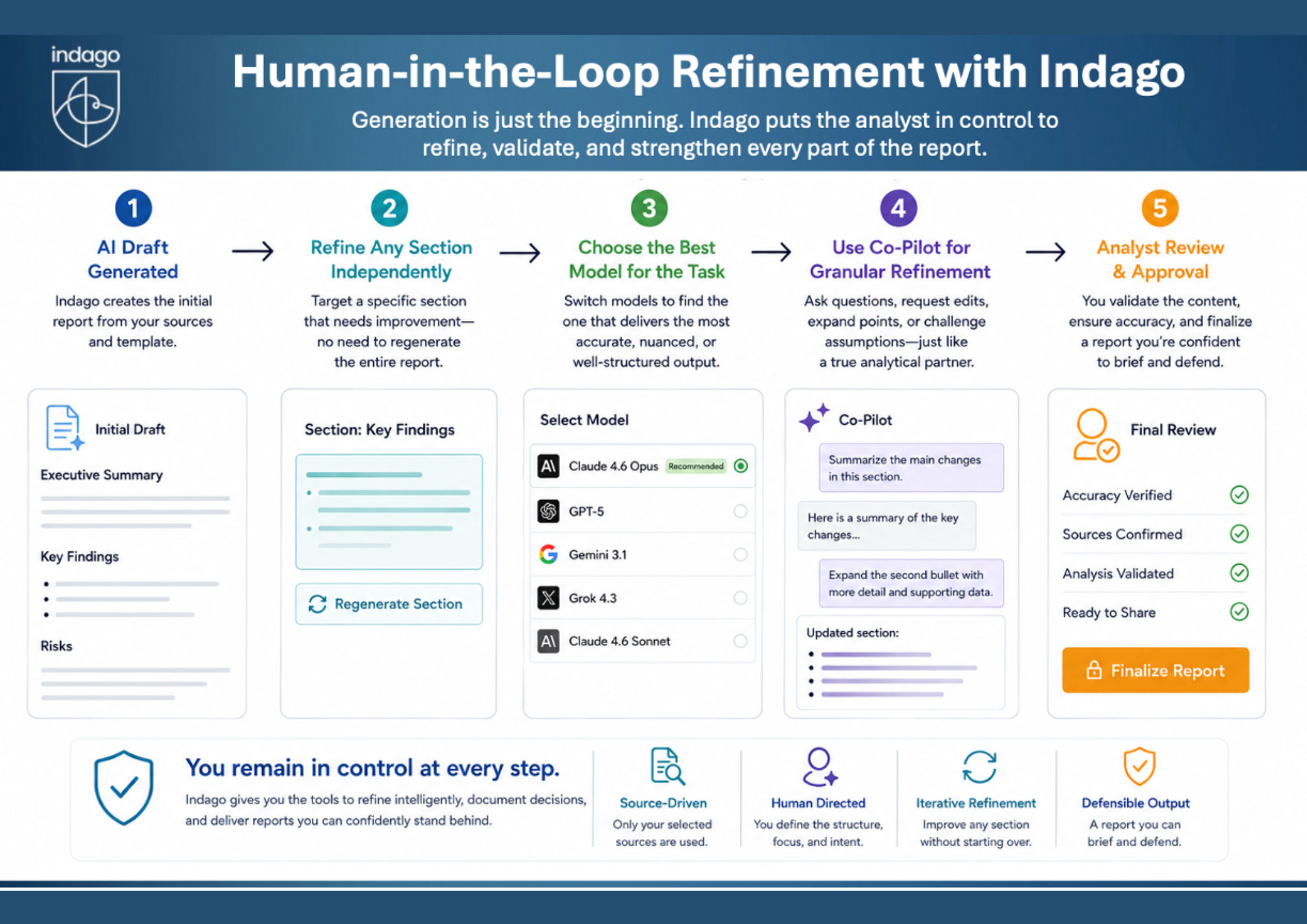
A generated draft is only the beginning. After a report is generated from a curated Collection against a defined Template, the analyst enters an editing environment where every section is individually addressable. If the threat assessment section is shallow, the analyst writes a targeted instruction — specifying what additional context, sourcing, or analytical framing is required — and regenerates that section without touching the surrounding text that already holds up. It’s incredibly powerful, and it stops the common problem of wholesale rewrites reintroducing errors into sections that were already fine.
Model selection compounds this control. Not every section needs the same kind of model. An executive summary for a non-technical audience calls for something different than a technical findings section mapping indicators to frameworks. Assigning the right model to the right section is an analytical judgment call, and making it explicitly keeps the analyst in the directing role rather than the reviewing role.
For deeper scrutiny, Co-Pilot is where the analyst's subject-matter expertise gets applied directly to the draft, at the sentence level, in real time. Say an analyst is reviewing a finished section on supply chain risk in Southeast Asia and suspects the confidence language overstates the certainty of the underlying sources. They bring that section into Co-Pilot and interrogate it directly: Is the sourcing strong enough to support this claim? Does this framing introduce bias that undermines the section's credibility? Is the confidence language consistent with the actual weight of the evidence? Co-Pilot doesn't answer these questions on its own — it responds to what the analyst brings, and the quality of that exchange reflects the analyst's expertise, not the model's.
The result is human presence legible at every stage: sources selected, template defined, draft reviewed, sections regenerated with modified instructions, Co-Pilot engaged to stress-test the analysis, final product approved.
If You Can't Brief It, You Didn't Write It
The test that separates AI-assisted work from AI-abdicated work: can you brief it? Not recite it — walk a room through the reasoning, defend the confidence levels, explain why one source was weighted over another, and answer questions the report didn't anticipate. If you can't, you didn't write the report. You only approved a draft you don't fully understand.
Intelligence analysts, risk professionals, and compliance teams are regularly asked to defend their products — to a supervisor, a client, a regulator, a principal making a high-stakes decision. Credibility comes from whether a qualified person directed the analysis, understands it, and is willing to put their name on it.
AI-assisted reporting, done correctly, produces a solid, defensible outcome. The analyst selected the sources, shaped the structure, reviewed every section, refined what didn't hold up, and can explain every substantive claim in the final product. The AI only compressed the drafting timeline.
Briefability is the test. If you can pass it, the process was sound. If you can't, the workflow—not the technology—needs to change.
Process Transparency Will Replace "AI or Human?" as the Professional Standard
The binary question — did AI write this? — is already losing relevance as a professional standard, because it was never measuring the right thing. Detection scores don't tell you whether a claim is sourced, whether the structure was deliberate, or whether a qualified person stood behind the conclusions. Forward-thinking organizations are moving past detection-based accountability toward something more durable: workflow disclosure. The emerging norm isn't "prove no AI touched this." It's "show me how the work was done."
Here is what that standard looks like in practice — a workflow disclosure statement that any team using AI-assisted reporting should be able to produce:
"This report was produced using an AI-assisted workflow. Source materials were curated and selected by the analyst prior to generation. The model generated an initial draft constrained to those sources. The analyst reviewed all sections, modified instructions where needed, regenerated sections that required revision, and approved the final product. The analyst is accountable for the analysis, the sourcing decisions, and the conclusions."
That statement describes a defensible process — something no AI detector score or percentage can tell you.
Workflow transparency is the institutional standard that replaces the detection debate. It doesn't ask whether AI was present — it asks whether the human was.
The Future of Professional Reporting Is Human-Directed, AI-Assisted
The organizations that get this right treat AI as a force multiplier for human judgment, not a shortcut around it. This is the workflow Indago was built to operationalize because every stage is designed to keep the analyst in front of the model, not downstream of it.
The most direct next step is seeing what a workflow built around that standard looks like in practice. Book a demo — and bring a real reporting challenge with you.