
9 Reports Supply Chain Risk Analysts Can Create Faster With Indago
Supply chain risk analysis has moved from a logistics footnote to a standing agenda item in boardrooms worldwide. Geopolitical volatility, sanctions enforcement, ESG mandates, and post-pandemic single-source exposures have converged into a discipline that now carries direct financial, legal, and reputational consequences at the executive level. According to WTW's 2025 Global Supply Chain Risk Survey, fewer than 8% of businesses believe they have full control over their supply chain risks, and 63% continue to experience higher-than-expected losses.
For the analysts responsible for producing this intelligence, every defensible report requires manual aggregation across trade databases, regulatory filings, sanctions lists, news sources, and financial disclosures — before a single word of analysis is written. The sourcing alone consumes hours that should be spent on judgment.
This article walks through nine of the most common supply chain risk report types and how each one can be produced faster — with greater sourcing rigor — using Indago as the workflow layer built to reduce research bottlenecks and return time to analysis.
1. Supplier Risk Profile
A supplier risk assessment is the foundational document of any third-party risk management program — a single profile that tells leadership whether a given supplier represents an acceptable risk. Done thoroughly, it draws on financial records, compliance certifications, audit results, adverse media, and ESG disclosures, often sourced from platforms that have no connection to each other.
Analysts building this profile manually toggle between financial databases, sanctions screening tools, news aggregators, and internal audit logs — copying findings into a working document before any actual analysis begins. The sources don't talk to each other, and neither do the formats they arrive in.
Indago's Collections feature resolves that bottleneck at the source. Analysts pull every relevant source into a single curated collection that the AI drafts from directly — no hallucinating. This produces a structured, sourced profile in a fraction of the time, with every claim traceable back to the materials the analyst deliberately selected.
2. Geopolitical Exposure Assessment
A geopolitical exposure assessment maps how a supplier's operating geography intersects with active risk vectors — armed conflict, trade tensions, sanctions regimes, regulatory shifts, and resource nationalism. For boards and risk committees, it answers one direct question: where are we most vulnerable if the political environment moves?
Geopolitical risk reporting requires monitoring dozens of regions and jurisdictions simultaneously. Analysts spend hours cycling through news aggregators, government advisories, and think-tank publications, then reconcile conflicting signals before a coherent picture emerges. According to WTW's 2025 Global Supply Chain Risk Survey, geopolitical risk is now a top concern for 55% of businesses — yet the research infrastructure most analysts rely on looks the same as it did a decade ago.
Indago's Search draws from over 140,000 indexed global sources across 27 languages, letting analysts construct precise queries — "rare earth export controls AND Vietnam" or "Section 232 tariffs AND steel" — and pull targeted results directly into a curated collection. What previously required hours of tab-switching now takes minutes — with every source selected by the analyst, not surfaced by an algorithm they don't control.
3. Sanctions & Export Control Screening
Sanctions and export control screening is one of the highest-stakes deliverables in third-party risk management. Analysts must verify that suppliers, distributors, and logistics partners are not designated under OFAC, BIS Entity List, or EU/UN frameworks — and document that verification for compliance and legal review. As enforcement has intensified, with multi-hundred-million-dollar penalties now routine, the evidentiary quality of screening records matters as much as the screening itself.
Manually, this means cross-referencing multiple list databases, monitoring BIS and OFAC enforcement releases, and tracking rapidly shifting designations — work that is both time-consuming and fragile. A supplier's compliance status can change overnight, and static spreadsheets offer no early-warning capability.
Indago’s Saved Searches let analysts re-run the same query against Indago's indexed source database on a regular cadence, surfacing new enforcement actions, designation announcements, and regulatory advisories without rebuilding the search from scratch each time. Analysts pull relevant developments directly into a Collection — a curated, timestamped source layer that becomes the foundation for an audit-ready screening report. The evidence chain is intact, traceable, and ready for legal review or board presentation without manual reconstruction.
4. Single-Source Dependency Report
A single-source dependency report identifies critical components, materials, or services sourced from only one supplier — exposing the organization to production halts, cost spikes, or forced renegotiation if that supplier encounters distress, disruption, or operational failure. As supply chain risk analysis has matured into a board-level discipline, mapping and monitoring these vulnerabilities systematically is no longer optional.
Manually, this report demands cross-referencing procurement data, supplier financial records, geographic concentration analyses, and industry coverage — often pulled from disconnected internal systems and external databases. The process repeats each sourcing cycle. Without a consistent structure, outputs vary by analyst and lose comparability over time — leadership is rarely comparing suppliers on the same terms.
Indago's Templates eliminate that inconsistency. Analysts build a standardized single-source dependency template once and reuse it across every sourcing cycle and every team member. The structure stays consistent, the sourcing stays rigorous — and when concentration risk surfaces, leadership is looking at outputs they can actually compare, not trying to reconcile three analysts' different definitions of critical dependency.
5. Logistics Disruption Brief
A logistics disruption brief delivers rapid situational awareness when a port closure, canal blockage, severe weather event, or transportation strike threatens active shipments and production schedules. It synthesizes route status, alternate pathway options, estimated delay windows, and immediate operational recommendations into a format that procurement and operations leadership can act on within hours.
Under manual conditions, the timeline simply doesn't cooperate. Analysts must simultaneously monitor shipping news, track real-time carrier advisories, cross-reference affected trade lanes, and assess supplier exposure — all while stakeholders are already demanding answers and the situation is still changing.
When an event breaks, analysts pull live news and carrier intelligence directly into a collection using the Data Retriever extension and built-in search. A pre-built disruption brief template structures the findings instantly, generating a sourced, stakeholder-ready draft in minutes rather than hours. When the window for action is measured in hours, that gap is everything.
6. ESG Compliance Summary
An ESG Compliance Summary evaluates a supplier's environmental practices, labor standards, and governance transparency against frameworks such as the EU CSRD, CSDDD, the UK Modern Slavery Act, and the Uyghur Forced Labor Prevention Act. For supplier risk assessment programs, it answers a direct question: does this vendor's conduct expose us to reputational, legal, or market-access risk?
Producing it manually means the information itself is fragmented. Sustainability disclosures live in annual reports. Forced labor risks are documented by NGO watchdogs. Governance violations surface in regulatory filings. Emerging controversies break in the news. None of it lives in one place, and analysts spend hours triangulating before a coherent picture forms — then formatting citations to match whatever standard the regulator in question expects.
Indago's built-in citation formatting handles that last step automatically. Analysts aggregate sustainability reports, NGO publications, regulatory filings, and adverse media, then generate a structured ESG summary with citations already matched to the framework in question — whether that's CSRD documentation standards or a Modern Slavery Act disclosure format. The output is traceable, audit-ready, and far faster to produce than anything assembled by hand — which matters most when a regulator asks how you reached your conclusion and the answer needs to be a document, not a memory.
7. Third-Party Cyber Risk Assessment
A third-party cyber risk assessment evaluates whether vendors, sub-processors, and logistics partners introduce exploitable vulnerabilities into your organization's digital perimeter. As cybersecurity risk surged in recent years, boards now expect documented evidence that supplier cyber exposure has been systematically assessed — not merely acknowledged.
Manually, this work sprawls. Analysts hunt across vendor security disclosures, breach notification databases, industry news, and regulatory advisories, then reconcile findings that arrive in incompatible formats. Determining whether a specific vendor has faced recent incidents, certification lapses, or enforcement actions requires hours of targeted searching before a single assessment sentence can be written.
Once the findings are in hand, translating technical vulnerability detail into something the board can act on is its own separate task — the two audiences need different depth, different language, and often different levels of urgency in the same report.
Indago's section-level model assignment addresses that directly. Analysts can apply one model to the technical findings — where precision and detail matter most — and another to the executive summary, where the priority is clarity and decision-relevance. What you get is a single report that reads right for both audiences, without a separate rewrite for each one.
8. Force Majeure Impact Report
A Force Majeure Impact Report documents how a sudden disruption — a port closure, natural disaster, armed conflict escalation, or infrastructure failure — affects active supplier relationships and production continuity. When an event breaks, procurement leadership and the board need a structured brief within hours, not days.
This is one of the hardest reports to produce quickly under manual conditions. Analysts must simultaneously monitor breaking news, cross-reference affected supplier locations, assess alternative sourcing options, and determine in real time whether force majeure provisions actually apply — all while the situation is still developing and stakeholders are already in the room asking questions.
Indago's Co-Pilot is built for exactly this kind of pressure. As breaking coverage comes in, analysts can ask Co-Pilot directly which suppliers in the collection are tied to the affected region, or which prior reports touched on the same facility — surfacing what's already been gathered instead of starting the search from memory. Combined with a pre-built Force Majeure template, that turns scattered breaking coverage into a sourced first draft in minutes. Decision-makers get a defensible brief while the situation is still unfolding, not after it's already resolved.
9. Supplier Financial Health Snapshot
A Supplier Financial Health Snapshot consolidates credit ratings, revenue trends, debt exposure, insurance coverage, and recent financial disclosures into a single-page assessment that risk committees can act on. When a key supplier shows signs of distress — missed earnings, credit downgrades, or rumors of restructuring — procurement leadership needs a defensible picture fast.
Manually, this means pulling financial statements, cross-referencing credit agency data, scanning trade publications for adverse coverage, and verifying subcontractor exposure — all before formatting begins. That adds up to hours of aggregation work for a report that may already be outdated by the time it reaches the board.
Indago's section-level model assignment matters here because not every model is equally strong at every part of this report. Some models are stronger at precise numerical analysis — debt ratios, revenue trend interpretation — while others are better suited to synthesizing qualitative adverse-media coverage into plain language. Analysts can assign the right model to each section instead of settling for whichever model handles the whole report adequately.
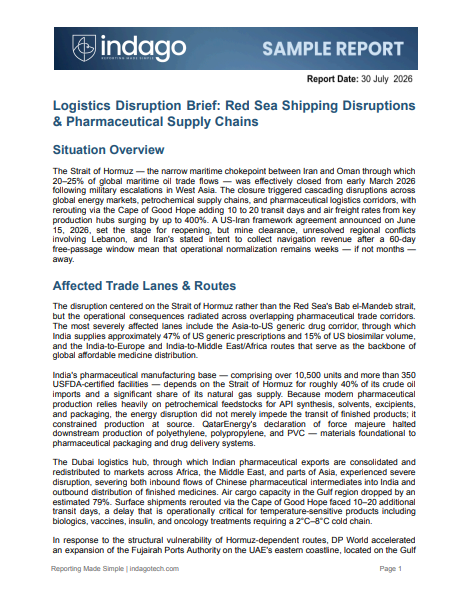
Download the Sample Report
Click here to get your copy of the example supply chain sample report Indago’s top analysts created in-platform to include the new details now necessary in these types of intelligence reports — structured, sourced, and free to use as a guide.
From Research Burden to Analytical Edge
Supply chain risk has become too complex, too regulatory, and too consequential for analysts to keep spending the majority of their time assembling information rather than interpreting it. Indago doesn't change the nine reports described in this article — it changes what analysts spend their time doing when they build them. With the bottleneck drastically streamlined, what remains is the judgment, the pattern recognition, and the institutional context that turns sourced intelligence into a decision.
If your team is still building these reports the slow way, the gap between your output and your organization's exposure is widening every reporting cycle.
Ready to close that gap? Book a personalized Indago demo.