
How Travel Risk Assessments Are Evolving
The Problem with Static
A travel risk assessment produced on Monday carries assumptions about roads, political stability, civil unrest potential, and local health conditions. By Thursday, one of those variables may have changed materially. By the following week, all four may have shifted. The assessment, however, remains unchanged — distributed, filed, and treated as current when it isn't.
Traditional country reports were designed for a threat environment that moved slowly enough for periodic updates to remain meaningful. But nowadays, conflict lines shift, protest movements escalate without warning, health advisories change within hours of new outbreak data, and political events trigger cascading effects on ground transportation and border access.
Everything is moving so much faster now. So much so that there’s a big difference between what security teams distribute and what travelers actually face when they land. That gap is where duty of care exposure begins. Organizations have legal and ethical obligations to take reasonable steps to protect employees who travel on their behalf. When the intelligence supporting those decisions is outdated, "reasonable" becomes difficult to demonstrate in after-action reviews, in litigation, and in the judgment of the employees who rely on that guidance.
What the current environment requires is a living intelligence product — an assessment that evolves with the environment it describes, updated as conditions change rather than on a fixed publication schedule.
What the Traditional Model Got Right
Country reports aggregating crime statistics, health advisories, political stability ratings, and entry requirements gave organizations a structured baseline. Travelers moved through relatively predictable environments, and a destination-level briefing — updated quarterly or annually — provided enough context to satisfy both security teams and legal counsel.
The model also established something durable: the principle that organizations have an obligation to inform travelers before they go. That duty of care instinct, even when imperfectly executed, drove the development of standardized risk ratings, pre-departure briefing protocols, and internal travel approval workflows.
What changed is the relationship between a destination's general profile and a specific traveler's actual exposure. A country-level risk rating captures aggregate conditions. It doesn't tell you whether a protest route intersects with a traveler's hotel, whether a healthcare delegation faces elevated exposure during a regional outbreak, or whether a specific executive's public profile increases their personal threat surface.
The shift from destination-focused to traveler-exposure-focused assessment treats the baseline as a starting point, not a finished product. What organizations increasingly require is an assessment that accounts for who is traveling, when, through what route, and under what conditions, layered on top of destination fundamentals.
What's Driving the Shift
Three forces are accelerating this shift, and they reinforce each other.
The first is the pace of change. Threat environments that once evolved over weeks or months now shift within hours. A political demonstration becomes civil unrest. A localized weather event disrupts the only viable evacuation corridor. A cyberattack on critical infrastructure ripples into physical access failures at ports and transit hubs. Assessment cycles built around quarterly updates or pre-trip briefings cannot absorb that kind of velocity.
The second driver is duty of care, which has become a substantive organizational obligation. Legal exposure has expanded in parallel with workforce mobility. Courts and regulators increasingly expect organizations to demonstrate that a risk assessment existed, that it was current, and that it was acted upon in proportion to the threat level. Meeting that standard requires documented, timestamped intelligence products that reflect what was known while the traveler was in the field.
The third is that senior leaders and high-profile personnel carry elevated risk profiles that a generalized destination assessment cannot capture. Route predictability, public exposure, media presence, and the geopolitical associations that come with a leadership title all create threat vectors specific to the individual. A GSOC team managing executive travel security must account for personal threat intelligence, pattern-of-life considerations, and jurisdiction-specific sensitivities that vary by traveler — not just by country.
What Modern Travel Assessments Look Like
Modern travel risk assessments are built from four integrated layers, each informing the others.
The first is destination risk: the baseline that traditional assessments were designed to produce. Crime rates, political stability, healthcare infrastructure, local legal frameworks: this layer still matters, and it still requires analytical rigor. Destination risk is the foundation everything else is built on.
The second layer is trip-specific context. A business traveler at a routine vendor meeting in a stable capital carries a different exposure than a senior executive at an investor summit in the same city during an election week. The purpose of the trip, the sites visited, the duration, the local itinerary, the profile of accompanying personnel — all of these factors reshape what the destination baseline actually means for a given journey.
The third is real-time factors: active developments that post-date any pre-departure briefing document, like civil unrest that escalates in 48 hours, severe weather intersecting with travel corridors, or a localized crime incident near lodging. These signals require a workflow capable of capturing and surfacing them while the traveler is in the field.
The fourth layer is traveler-specific considerations: the individual's profile, role, exposure, and any factors that elevate or modify the standard risk picture. Executive travel warrants its own calculus here: public-facing profiles, predictable routines, and high-value status all create targeting surfaces that destination-level analysis does not capture.
The GSOC's Evolving Role
The traditional GSOC function in travel risk was largely distributional: pull the country report, attach the advisory, and push it to the traveler or the manager requesting clearance. The value was in aggregation and delivery.
As travel risk assessments have become more dynamic, the GSOC's role has shifted from packaging existing intelligence to producing decision-ready analysis on compressed timelines. The work now looks different in practice. An analyst correlates a destination's current threat picture with a specific itinerary, a traveler's profile, a departure window, and whatever has changed in the last 48 hours.
This shift places new demands on how GSOCs are staffed, tooled, and measured. Turnaround time matters differently when the product is time-sensitive by nature. An assessment produced six hours after a request for a trip departing tomorrow has limited operational value. The pressure to synthesize faster without sacrificing accuracy is the central tension.
The GSOC's credibility increasingly rests on helping decision-makers move confidently. That means producing outputs that are traceable, consistently structured, and calibrated to the traveler's actual exposure.
The Infrastructure Behind Duty of Care
Producing a modern travel risk assessment is as much a documentation and workflow challenge as an analytical one. The assessment itself may draw from a dozen source types, span multiple geographic layers, and need to reach different audiences simultaneously, like a security director making a go/no-go call, a traveler needing practical guidance, and a legal team needing defensible evidence of due diligence.
Structured reporting platforms help with this directly. When analysts can load a pre-built template that already defines the sections, personas, and sourcing logic for a corporate travel risk assessment, the time between collection and first draft collapses. With Indago, the analyst's focus shifts to interpretation because its initial drafts are 75 to 85% complete.
For travel risk work specifically, the ability to generate tailored versions of the same assessment for different audiences without rebuilding the underlying analysis each time saves both time and consistency. The same intelligence base, routed through different templates and personas, produces outputs calibrated to each reader's decision frame.
Travel assessments draw from more source types than almost any other intelligence product — news feeds, embassy advisories, internal incident logs, and medical intelligence, each formatted differently and arriving on a different timeline. A platform that ingests all of it into a single structured collection reduces both error risk and production time.
Full source attribution woven through the report from the start means that when legal asks where an assessment came from, the answer is already in the document. When a traveler's situation changes mid-trip, the analyst returns to the same sourced foundation rather than rebuilding under pressure.
Before the Next Trip
The organizations that treat travel risk as a living function — structured, source-cited, and analyst-controlled — are the ones their people trust when a situation changes mid-trip. The infrastructure behind it will determine how well duty of care holds under pressure. If you want to see how structured templates and unified reporting workflows apply to travel risk and GSOC environments, book a demo and bring your current process with you.
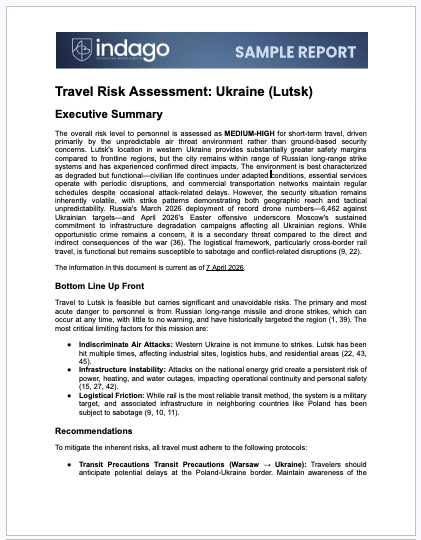
Download the Sample Report
Click here to get your copy of the example travel assessment Indago’s top analysts created in-platform to include the new details now necessary in these types of intelligence reports — structured, sourced, and free to use as a guide.