
How Pharmaceutical Companies Are Using Intelligence Reporting to Track Supply Chain Risk
Most pharmaceutical supply chain teams find out about sourcing problems the same way everyone else does: through a news alert, a supplier email, or a colleague forwarding something they happened to read. The information arrives after the fact, stripped of context, and rarely connected to the inventory positions or regulatory timelines that determine how much it actually matters.
A procurement manager learns that a key API supplier in Gujarat has suspended operations from a paragraph buried in a trade publication story that ran forty-eight hours after the shutdown began. The internal escalation meeting happens on day three, by which point the gap between available inventory and the next confirmed delivery is already wider than safety stock can cover. The conversation is about which products are most exposed, not how to manage the risk.
What makes that scenario so costly is that it was avoidable. The information existed well before the shutdown: export restriction signals, financial stress indicators from the supplier's parent company, and regulatory inspection trends at the facility. None of it was being watched — not because the signals weren't there, but because no one was positioned to receive them.
API Sourcing Risk in High-Risk & Sanctioned Regions
India holds the largest share of active API manufacturing capacity for U.S. medicines — roughly 48% of all active API Drug Master Files as of 2024, according to USP's Medicine Supply Map. China's direct share of finished API production is smaller than widely reported, but its role in the raw materials and chemical intermediates that feed into API production creates a layer of indirect exposure that doesn't show up in finished-product import statistics. When Chinese supply of a key starting material tightens, Indian manufacturers feel it first — and U.S. finished-dose manufacturers feel it second, often without visibility into why. That upstream concentration means a single export restriction or facility shutdown can ripple through multiple manufacturers simultaneously, with no viable alternative on a usable timeline.
Sanctions and export controls add a second layer of risk. A supplier may be fully operational but legally inaccessible. For example, OFAC designation lists, the Commerce Department's Entity List, and sector-specific export controls have all been applied to chemical and pharmaceutical supply chain entities in recent years. Can a supplier legally deliver — not just operationally?
The analytical goal is anticipating constraints early enough to act on them. Different signal types serve that goal at different lead times:
Regulatory filing activity reveals early instability: new or lapsed Drug Master Files often change months before any public announcement.
Import data captures rerouting in progress: shifts in declared country of origin visible in HS code-level trade flows can indicate supply restructuring while it is still reversible.
Geopolitical indicators, like sanctions designations, export licensing changes, bilateral trade policy moves, frequently telegraph constraints weeks ahead of operational impact.
DSCSA Enforcement (2025–2026)
Most pharmaceutical supply chain professionals know the Drug Supply Chain Security Act (DSCSA) as a compliance obligation, but it tends to live in the legal and regulatory affairs column until something stops moving.
The Act's interoperability requirements demand that every trading partner — manufacturers, wholesalers, third-party logistics providers, dispensers — exchange and verify serialized, unit-level traceability data in a standardized format. It follows each package from manufacturing through to the point of dispense, which means any gap in the data chain creates a break that can halt product movement. A distributor still issuing paper pedigrees, a 3PL without a compliant system, a smaller manufacturer behind on serialization each represents a point where shipments stop moving and product sits unverifiable at the receiving dock.
The FDA's enforcement posture shifted significantly in 2025. The end of the stabilization period means regulators are moving from guidance to active verification, and trading partners who cannot demonstrate interoperability are being removed from distribution networks because their counterparties cannot absorb the liability. That mechanism matters: enforcement is partly market-driven, which compresses the timeline in ways a standard citation cycle wouldn't. A rigorous supply chain risk assessment accounts for this, scoring DSCSA readiness alongside financial health and quality certification.
Tariff Volatility & Reshoring Pressures
Reshoring pharmaceutical manufacturing sounds straightforward in a policy brief, but it becomes considerably messier when you're working with a 24-month FDA approval timeline for a new manufacturing site, a generic product with 8% margins, and a tariff environment that changes quarterly.
Section 301 tariffs on Chinese goods, combined with the broader U.S. trade policy trajectory through 2025 — including proposed tariff frameworks specifically targeting pharmaceutical imports — have pushed API sourcing economics and finished dose form imports into uncertain territory. Manufacturers that were running reshoring scenarios as contingency exercises are now running them as live network redesign projects, and the executive orders directing federal agencies to assess pharmaceutical supply chain vulnerabilities accelerated that shift.
For branded manufacturers with margin to absorb transition costs and fund new supplier qualification, this is disruptive but navigable. Generic manufacturers operate on thin margins by design. When input costs rise or a key supplier becomes uneconomical, passing the increase downstream isn't an option. Qualifying a new manufacturing site under the ANDA process takes two to three years minimum.
A well-run supply chain risk reporting function is tracking cost signals at the commodity level, building visibility into lead time changes by supplier tier, and treating the regulatory approval pipeline for alternative suppliers as live operational data.
AI-Powered Predictive Risk Alerting
According to the 2025 LogiPharma AI Report, 53% of pharmaceutical supply chain executives are now adopting AI for predictive risk alerts — up from roughly 30% just a few years prior. Adoption rates measure intent and initial deployment, but it doesn’t measure how successful those tools are for catching risks before they materialize.
Predictive alerting in a supply chain intelligence context is so much more than just a threshold-based dashboard alert. It means structured, continuous monitoring of leading indicators — the kind of signals that precede a disruption rather than confirm one. That means tracking FDA drug shortage database updates, CMO capacity announcements signaling production constraints, country-specific API export quota changes from India or China, and export restriction language appearing in trade policy documents before the shortage surfaces in your inventory system.
AI is especially useful when processing high volumes of data across multiple languages and sources — more than any analyst team can absorb manually at scale. An AI system can flag that an API manufacturer has received three adverse regulatory citations in six months. Assessing whether that pattern signals imminent supply risk or routine compliance activity still requires an analyst who understands that regulatory environment and supplier relationship in context.
In practice, the workflow with the proper instructions looks like this: the system surfaces the pattern and timestamps it; the analyst assesses materiality, cross-references against contract terms and buffer stock levels, and decides whether to escalate or monitor.
Organizations that treat signal tuning as an ongoing discipline get more from both the AI and the analysts over time.
What a Modern Pharma Supply Chain Risk Report Looks Like
A well-constructed pharma supply chain risk report starts with a sourcing exposure summary — a clear-eyed map of where the organization's API dependencies are concentrated, which suppliers sit in jurisdictions with elevated geopolitical or regulatory risk, and what percentage of critical drug volume flows through single-source arrangements. It draws on trade data, regulatory filings, supplier financial disclosures, and geopolitical monitoring feeds. That sourcing map then determines which trading partner relationships deserve the closest scrutiny, since DSCSA traceability obligations run through the same supplier and distributor connections.
When a distributor is constrained by DSCSA compliance gaps, switching to an alternative supplier under tariff pressure becomes a compliance re-qualification exercise with its own timeline and regulatory approval requirements. In a volatile tariff environment, strong supply chain risk reporting tracks leading indicators alongside current duties: proposed rule changes, antidumping petitions, bilateral trade negotiations.
The final layer is signal monitoring — regulatory announcements, supplier news, geopolitical developments — that analysts bring into the report as conditions change, updating specific sections rather than rebuilding the entire product from scratch. Platforms like Indago support this kind of synthesis workflow, helping analysts convert monitoring data into prioritized, sourced intelligence that keeps the sourcing map, compliance posture, and tariff picture current.
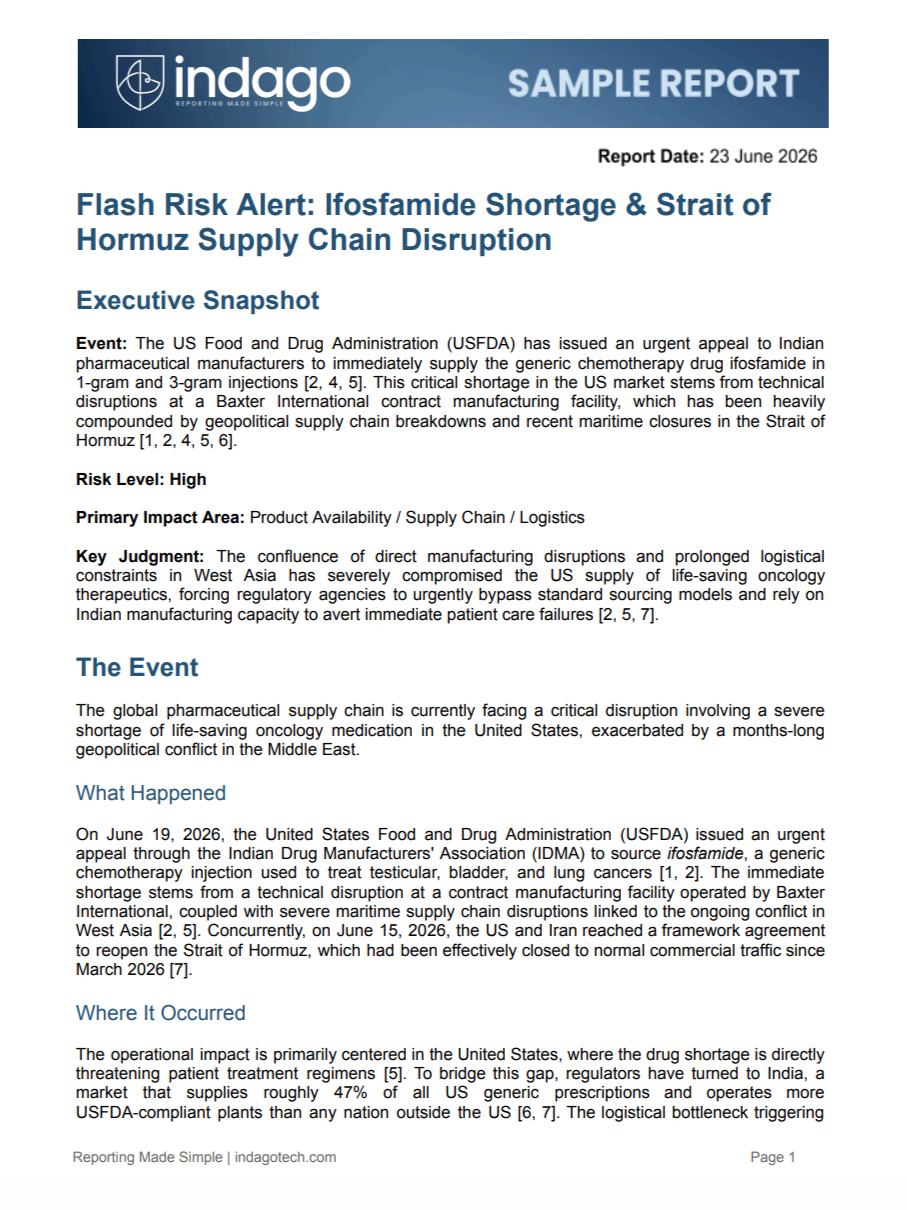
Download the Sample Report
Click here to get your copy of the example pharmaceutical supply chain assessment Indago’s top analysts created in-platform to include the new details now necessary in these types of intelligence reports — structured, sourced, and free to use as a guide.
The Infrastructure Already Exists
Pharmaceutical supply chains have become too fast-moving for reactive monitoring to hold. The organizations ahead of this have already shifted from reactive monitoring to a continuous intelligence function that surfaces risk before it reaches inventory. Book a demo to see what that looks like in a live reporting environment — sessions are structured around your specific context.